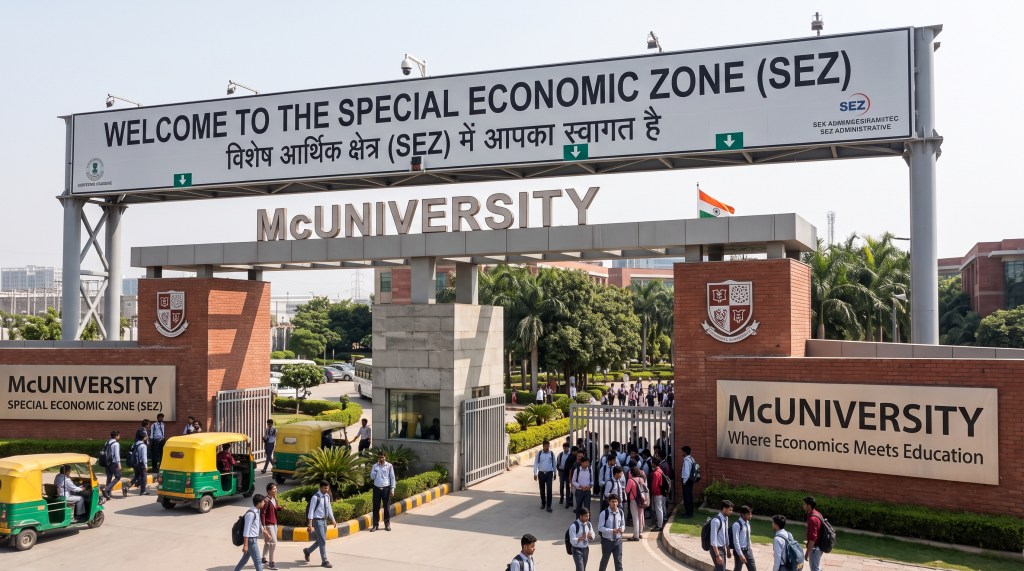
To better understand the desperation coursing through higher education, look past the gothic quads of Britain and the sunlit sandstones of Australia, and look instead at the skyline of Gandhinagar, Gujarat.
There, inside the glass-and-steel canyons of Gujarat International Finance Tec-City (GIFT City)—a deregulated, multi-currency Special Economic Zone (SEZ) designed for offshore banking, financial derivatives, and tech conglomerates—a curious set of corporate tenants has moved in. Wedged between private equity firms and fintech clearinghouses sit the overseas branch outposts of Australian and British universities: Deakin, Wollongong, and Queen’s University Belfast. Further south and north, in corporate office developments outside Bengaluru and Gurugram, institutions like the University of Southampton and the University of Liverpool are cutting ribbons on their own mainland installations.
The promotional materials present these developments in the breathless vocabulary of post-colonial cosmopolitanism. We are told this is a historic era of bilateral collaboration, “democratizing access” to world-class pedagogy and delivering prestigious Western credentials directly to Indian soil.
Strip away the marketing gloss, however, and the reality is far crasser: the Western university is running an offshore retail franchise.
Having exhausted domestic balance sheets, run into hard government immigration caps, and faced structural insolvency at home, vice-chancellors from London to Melbourne have taken their corporate playbooks to South Asia. Rather than exporting intellectual community, sovereign inquiry, or affordable education, they are opening strip-mall credential mills inside tax-free corporate bubbles—extracting local wealth to prop up their insolvent mother ships on the other side of the planet.
The Mother Ships Are Sinking
To understand why a vice-chancellor in Coventry or Wollongong is opening a storefront in Gujarat, you only need to look at their domestic spreadsheets.
Over the past two years, the economic model of Anglosphere higher education suffered a structural heart attack:
- In the United Kingdom, domestic undergraduate fees have been frozen at £9,250 for nearly a decade, losing over a third of their real purchasing power to inflation, while the tightening of dependent-visa rules wiped out the lucrative, high-margin international master’s pipelines that kept Russell Group and post-92 balance sheets solvent. Over sixty British universities are in the middle of emergency redundancies, department closures, and hiring freezes.
- In Australia, federal caps on international student commencements and visa crackdowns delivered a blunt shock to institutions that had spent twenty years treating international education as a volume-driven cash-cow export to fund capital debts and executive bonuses.
For decades, the institutional strategy was simple: recruit full-fee-paying Indian and Chinese students, bring them to the domestic campus, charge them quadruple the domestic rate for a seat in an overcrowded lecture theatre, and pocket the surplus.
The moment domestic governments restricted student migration to cool regional housing markets or respond to geopolitical tensions, that extraction loop severed.
Did Western university administrations downsize their executive salaries, prune their corporate marketing departments, or dismantle their real-estate debt?
Of course not. Instead, they took advantage of India’s newly loosened regulatory architecture—the University Grants Commission (UGC) Foreign Higher Educational Institutions Regulations and the International Financial Services Centres Authority (IFSCA) framework at GIFT City.
The regulatory changes handed Western universities their holy grail: the legal right to set up wholly owned, autonomous branch campuses, set their own admissions criteria, determine their own fees without government caps, and—crucially—repatriate surplus capital out of India and back to their home institutions.
If the students cannot travel to the tollbooth in Sydney or Southampton, the university simply ships the tollbooth to India.
The McDonaldization of the Imperial Degree
What does an “international campus” actually look like inside an offshore special economic zone?
It does not look like the Bodleian Library or the great halls of Melbourne. It looks like an executive floorplate in a commercial office park.
The offshore branch campus is higher education reduced to a fast-food franchise model:
- The Stripped-Down Curricular Menu: You will not find robust offerings in theoretical mathematics, philosophy, regional history, or pure foundational sciences in GIFT City or Gurugram. Branch campuses offer a hyper-monetized, vocational monoculture: MSc in Fintech, Master of Business Analytics, Cybersecurity, and Data Science. These are low-overhead, computer-lab-only programs designed to funnel credentialed workers into the corporate office parks down the road.
- The Price Tag Arbitrage: These imported degrees are pitched as a “bargain” compared to traveling abroad, yet they demand dizzying sums from local families—ranging from 15 to 40 lakh INR (₹1.5M to ₹4.0M) for two- to three-year programs. The exchange rate is 1 Indian Rupee (INR) = approximately $0.0103 US Dollar (USD). For an Indian family, where the median household income (two adults) is approximately ₹24,000 per month, this is life-altering wealth, sold on the implicit promise that a parchment bearing a foreign heraldic crest will yield an automatic return on investment.
- The Cut-Rate Labor Force: How do the mother ships keep operating margins high? Not by flying tenured professors out to live permanently in Gujarat. The instructional labor relies heavily on local, contingent contract lecturers (locatio operarum) hired at prevailing regional pay scales—a tiny fraction of what a lecturer in London or Sydney earns—supplemented by occasional “flying faculty” who arrive for a two-week modular sprint.
The university slaps an ancient coat of arms on the marketing brochures, rents two floors above a multinational bank, hires local instructors on seasonal contracts to grade centralized slide decks, charges 30 lakh rupees, and wires the surplus revenue back to cover deficits in Britain or Australia.
It is Starbucks higher education: standardized syrup, local minimum-wage baristas, and an overseas executive team extracting the franchise royalty.
The PSA Antidote: Why India is the Natural Epicenter for The Great Decoupling
The spectacle of British and Australian universities setting up tax-haven franchises in India exposes the central fallacy of the institutional paradigm: the absurd idea that scholarly exchange requires a corporate real-estate conglomerate.
India does not need imported Western university landlords. What it needs—and what its material and cultural conditions are exquisitely positioned to support—is the Professional Society of Academics (PSA).
In fact, India is arguably some of the most fertile ground on the planet to execute The Great Decoupling.
Here is why:
1. The Demographic Engine and the Ad-Hoc Labor Crisis
India’s higher education system is the second-largest in the world, educating over 43 million students across more than 50,000 colleges and universities, with millions more seeking entry every year. Yet behind this staggering demand lies a catastrophic labor crisis: the systematic exploitation of the Indian academic. To meet the National Education Policy (NEP 2020) target of raising the Gross Enrolment Ratio (GER) in higher education to 50% by 2035, estimates indicate India needs between 1,500 and 2,500 new universities, 10,000 to 12,000 new colleges, and approximately 1.5 to 3.3 million additional faculty members to service an estimated 70 to 86 million total students (an increase of 25 to 40+ million additional seats above current enrolment).
Across central, state, and private universities, hundreds of thousands of brilliant, UGC-NET-qualified scholars and PhD holders are trapped as “ad-hoc,” “guest,” or “contract” lecturers. They earn insulting stipends of ₹25,000 to ₹50,000 a month, often working without benefits, office space, or job security, despite delivering the overwhelming majority of undergraduate instruction. Meanwhile, bloated university administrations and private trust syndicates siphon off immense revenues.
In public/government universities (General Programs) the range of tuition is ₹10,000 – ₹200,000 per year, while the per semester average/range is ₹5,000 – ₹100,000 per semester. At institutes of national importance (IITs, NITs, Central Universities), the annual range is ₹100,000 – ₹500,000, while the per semester average/range is ₹50,000 – ₹250,000.
Under the PSA, Portable Licensure completely upends this extractive pyramid:
- An Indian scholar does not wait years for an elusive, corruptly allocated permanent university post (permanent seat).
- Licensed by an autonomous, professional Guild (Societas) of peers, every qualified scholar becomes an independent, sovereign higher education practitioner.
- A practitioner running small, rigorous cohorts of 12 to 15 students charging an accessible direct fee of just ₹15,000 to ₹25,000 per student per semester-long module can generate an annual professional gross of ₹15 to ₹25 lakh—tripling or quadrupling the typical ad-hoc salary while retaining absolute autonomy over their teaching and research. Here are PSA financial analyses for other countries: United States, United Kingdom, Canada, Australia, and Ecuador.
2. Indigenous Scholastic Heritage: The Unmediated Covenant
The Western corporate university (Universitas) was imported into India under colonial rule as an administrative credentialing bureaucracy designed to produce clerks for the imperial state (the infamous Macaulayite civil-service pipeline).
India’s authentic intellectual heritage was never based on an industrial employer-employee hierarchy. For millennia, Indian higher learning operated on the unmediated covenant between master and student:
- The Guru-Shishya tradition was fundamentally a relational, decentralized educational covenant, not a state-backed real-estate conglomerate.
- The ancient centers of higher learning—from Takshashila and Nalanda to the autonomous tols, madrasas, and regional scholarly circles—were assemblies of sovereign masters, not corporate franchises selling degrees in an office park.
- The PSA’s core model—Direct Contracts between master and apprentice, parsimonious practice, and peer recognition—resonates deeply with South Asia’s historical educational ethos. It strips away the alien, 19th-century European bureaucratic middleman, restoring the sovereignty of the teacher and putting higher education tax dollar vouchers directly in the hands of citizen-students.
3. Public Digital Infrastructure: The World’s Best Rails for Parsimonious Practice
To operate a decentralized, independent academic practice efficiently, a scholar needs frictionless payment systems, accessible identity verification, and community learning spaces.
India possesses a digital public infrastructure:
- Frictionless Direct Contracts via UPI: The Unified Payments Interface (UPI) allows students to execute micro-payments and direct contractual tuition transfers to independent practitioners instantly, without credit-card processing fees, institutional bank holds, or administrative friction.
- Open Credentialing Rails: India’s digital initiatives (like the Academic Bank of Credits and DigiLocker) provide the exact technical substrate needed to anchor the Public Practice Record (PPR) of PSA. A student’s assessed competencies, verified seminar projects, and Course Difficulty Scores (CDS) can be registered transparently on open digital ledgers that are produced by professional peer review.
- Hyper-Local Physical Nodes: Under Parsimonious Practice, an Indian academic does not need a ₹200-crore ($20.9 million USD) campus. Every major Indian city, tier-2 hub, and town is filled with municipal libraries, civic cultural centers (sabhas), study circles, and modern co-working hubs. A scholar can convene an elite, face-to-face seminar for a fraction of institutional real-estate costs.
4. Eradicating the 40-Lakh Middleman Tollbooth
Why should an Indian family liquidate land or take on crushing loans to pay 30 or 40 lakh INR to a Western university administration to take a seminar delivered in an office tower?
Under the PSA:
- The student contracts directly with the sovereign practitioner.
- A complete, multi-course academic program can be assembled through direct seminars with elite Indian and international scholars for an aggregate investment of ₹2 to ₹4 lakh ($2,068 to $4,136 USD) over three years—a 90% reduction in cost.
- Indian wealth stays within the domestic knowledge economy, funding local scholars, local research assistants, and civic community spaces, rather than being wired overseas to subsidize bond debts in Britain or Australia.
5. True Transnational Equality Through the Borderless Guild
Under the legacy branch-campus model, academic exchange is deeply colonial: the Western university acts as the imperial mother ship; the Indian operation is a subordinate sales outpost.
The PSA replaces corporate hierarchies with a borderless, horizontal Guild:
- Academic authority is certified by a professional (trans)national peer society.
- A computer scientist in Hyderabad and a logician in Manchester hold the exact same inalienable Portable License. They meet as sovereign professional equals, not as corporate managers and offshore contract labor.
- Scholars can co-convene seminars, share doctoral mentorship, and collaborate on research directly, using local civic spaces and decentralized digital networks, completely bypassing the corporate vice-chancellors and their franchise taxes.
Close the Offshore Strip Malls
To the vice-chancellors cutting ribbons in GIFT City, congratulating yourselves on your “global footprint”: the world sees this maneuver for what it is.
You are not educational visionaries. You are real-estate franchisors running out of cash at home, hawking imported credentials in special economic zones to keep your corporate administrations afloat.
Higher education was never supposed to be an export commodity shipped across borders like processed food. It is a sovereign, unmediated encounter between the teacher who knows and the student who seeks to understand.
India has its own towering intellectual traditions, its own brilliant scholars, and millions of capable students. It does not need foreign corporate landlords setting up tollbooths in its office parks.
The digital tools are ready. The physical spaces are open. The scholars and students are waiting.
It is time to end the imperial franchise model. It is time to execute a Great Decoupling, claim our Portable Licensure, and build a borderless Professional Society of Academics in India.


Leave a Reply