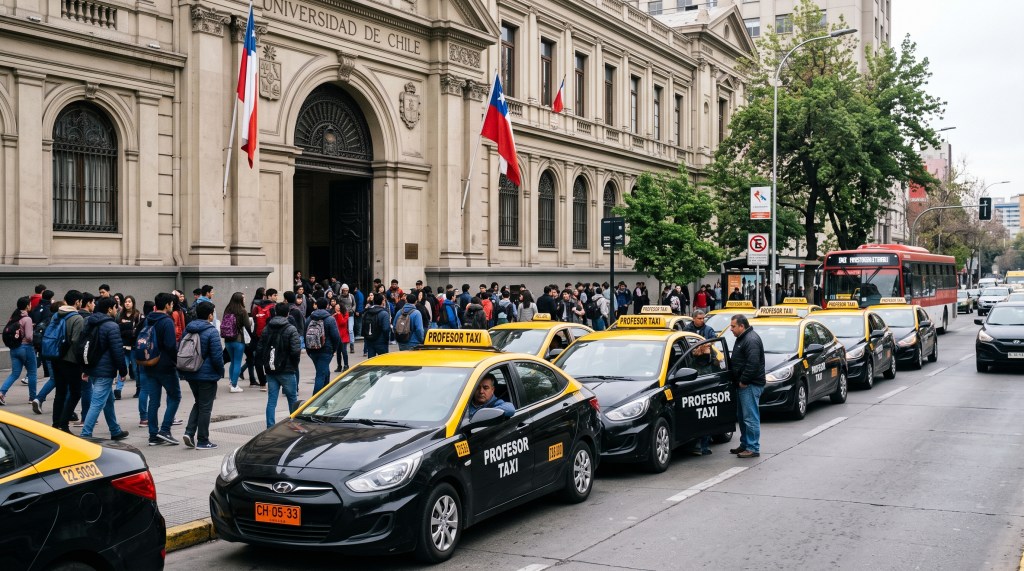
At 7:15 AM on a Tuesday, step onto Line 1 of the Santiago Metro at Los Héroes. Amid the crush of commuters hurtling eastward toward Providencia and Las Condes, you will inevitably spot them: men and women in their thirties and forties, clutching beat-up messenger bags heavy with laptops, paperbacks, and stacks of ungraded midterms.
They hold master’s degrees from the Universidad de Chile, doctorates from European research universities, and extensive publication records. Yet by 8:00 AM, they are standing before thirty students in a rented, windowless basement of a private university in Providencia. By 11:30 AM, they are sprinting back down to the turnstiles, checking the transit app to see if they can catch a bus down Avenida Vicuña Mackenna in time to teach a two-hour section in San Joaquín. By 4:00 PM, they are on another cross-town commute toward a third institution in Huechuraba or Maipú.
In Chilean academic parlance, they are known by an infamous, darkly comic moniker: the profesor taxi.
They are the intellectual engine of Chilean tertiary education. Across the metropolitan corridors of Santiago, Valparaíso, and Concepción, more than 65 percent of all undergraduate course sections are taught by this hyper-casualized, itinerant professoriate.
They are hired on precarious, non-renewable boletas de honorarios—freelance tax receipts that treat the instruction of human minds like a one-off plumbing repair. They earn as little as 10,000 to 15,000 Chilean pesos ($10 to $15 USD) per instructional contact hour, in a country where the average hourly rate across sectors ranges from $8.10 to $11.50.
They receive zero pay for class preparation, zero compensation for grading essays on the metro, zero sick leave, no health insurance, and zero research allocations. When the Southern Hemisphere summer arrives in January and February, their contracts evaporate into thin air, casting them into an annual, two-month unpaid drought during which they must scrape together rent from odd jobs while waiting to hear if their classes will be renewed for the autumn semester.
Now lift your eyes from the metro platform and look up at the Santiago skyline.
Along the Costanera and throughout the financial districts, private university holding companies erect gleaming, multi-story campus monuments encased in reflective glass, brushed titanium, and polished Italian marble.
How can an industry that pays its core workforce $12 an hour afford to build billion-peso architectural temples?
Because the Chilean corporate university is not an educational institution. It is an unregulated real-estate cartel masquerading as a school.
The 1981 Laboratory and the Real-Estate Loophole
To understand the systemic misery of the profesor taxi, you have to trace the legal architecture back to the Chicago Boys and the military dictatorship’s radical higher education shock therapy: Decree Law No. 1 of 1981 (DFL 1).
Under DFL 1, Chile became a laboratory for the neoliberal financialization of the university. The traditional public university system was forcibly dismantled and fractured into regional fragments. In its place, the state opened the floodgates to a predatory private market, establishing an explosion of new commercial universities, professional institutes (IP), and technical training centers (CFT).
On paper, the Chilean legal code contained a seemingly noble safeguard: by law, private universities were required to be non-profit organizations (corporaciones de derecho privado sin fines de lucro).
In practice, the founders and financial conglomerates backing these new universities invented a brazen corporate shell game that bypassed the statute entirely: the sociedad inmobiliaria (real-estate holding company).
The scam operates with mechanical precision:
- The investors and university boards establish a non-profit university entity to capture students, collect government-backed student loan debt (the notorious Crédito con Aval del Estado or CAE), and receive public subsidies.
- The exact same investors establish a parallel, for-profit commercial real-estate holding company (sociedad inmobiliaria).
- The real-estate company buys or builds campus land, office towers, and sports facilities.
- The non-profit university then signs long-term, non-arm’s-length leases with its own founders’ real-estate company at artificially inflated, above-market rental rates.
Through this structural siphon, billions of pesos in student tuition, interest-bearing bank debt, and state vouchers flow into the “non-profit” university, wash through its operating accounts, and exit directly into the private pockets of the real-estate syndicate as tax-advantaged property leases.
The corporate campus is not built to serve students or house scholars. The building is the profit. The campus is an extractive real-estate asset, designed to justify massive capital transfers from the non-profit educational entity to the for-profit property owners.
The Scholar as Cheap Fuel
Where does the money to pay these inflated real-estate rents come from?
It cannot come from state research funds, which are meager and fiercely contested. And it cannot come entirely from student tuition, because even with extortionate bank loans, there is an upper limit to what Chilean working- and middle-class families can bear.
The surplus is extracted directly from the flesh of the academic workforce.
In the balance sheets of the Chilean university holding company, the professor is not an intellectual asset, a mentor, or a colleague. The professor is an operational liability—a line-item expenditure (locatio operarum) that must be squeezed to the absolute minimum to preserve the margin for the real-estate lease.
Every peso paid to a full-time, tenured academic with healthcare, research time, and a physical office is a peso stolen from the sociedad inmobiliaria.
Therefore, the corporate university model demands the systematic eradication of the tenured faculty line. It replaces permanent departments with revolving-door rosters of contingent profesores taxi hired on boletas de honorarios.
By paying an adjunct only for the 90 minutes they stand at the whiteboard, the university avoids paying employer pension contributions (AFP), health insurance (FONASA/ISAPRE), vacation pay, severance liabilities, and office overhead.
The university builds glass towers in Las Condes, but refuses to provide its teachers with a desk, forcing scholars to hold office hours on park benches or over the din of institutional food courts.
The profesor taxi is not a temporary market inefficiency. The profesor taxi is the business model. The university functions as a high-end property slumlord that burns contingent academic labor as disposable fuel.
The Failure of the Reformist Panopticon
For twenty years, the Chilean political establishment has attempted to fix this crisis with bureaucratic regulation and financial tinkering. Every attempt has failed.
When millions of students paralyzed the nation during the 2011 student protests (Movimiento Estudiantil), demanding an end to systemic profiteering (lucro) and educational debt, the political class responded with technocratic oversight:
- They established the Superintendencia de Educación Superior to audit real-estate transactions and enforce the ban on commercial profit.
- They expanded institutional accreditation through the Comisión Nacional de Acreditación (CNA), requiring universities to demonstrate minimum ratios of “contracted” faculty.
- They enacted Gratuidad under Michelle Bachelet, covering tuition for the poorest 60 percent of students, and now Gabriel Boric proposes the FES (Financiamiento Público para la Educación Superior) to replace the bank-run CAE with a state income-contingent debt garnishment.
None of it has stopped the exploitation.
The university holding companies simply adjusted their legal contracts. To satisfy CNA accreditation criteria without spending money, institutions invented the contrato basura: fractional, nine-month contracts that pay a pittance, maintain the profesor taxi workload, and terminate every December 31st to prevent the accumulation of statutory labor rights.
You cannot regulate away an extractive monopoly while leaving the monopolistic institutional employer holding the keys to the classroom.
As long as the university corporation (Universitas) retains the exclusive right to enroll students, grant degrees, and lease real estate, every regulatory reform will simply be absorbed by corporate lawyers, while the adjunct continues their daily race across the city on an empty stomach.
The PSA Antidote: The Great Decoupling
The crisis of Chilean higher education will never be resolved by substituting private bank debt for a state income tithe, nor will it be resolved by filing compliance complaints with the Superintendencia.
The only structural solution is The Great Decoupling: severing the academic profession (Societas) from the predatory real-estate corporation (Universitas).
The Professional Society of Academics (PSA) destroys the extractive power of the sociedad inmobiliaria by returning higher learning to its sovereign, human-scaled foundation.
Here is how the PSA dismantles the profesor taxi economy:
1. Portable Licensure Eradicates the Corporate Gatekeeper
Why does a scholar with a doctorate accept 12,000 pesos an hour on a non-renewable tax receipt?
Because the university cartel has criminalized the independent practice of scholarship. Under the current regime, an academic’s knowledge has zero economic legitimacy unless it is rubber-stamped by an accredited institutional corporation. If a professor refuses the university’s insulting contract, they cannot practice their vocation.
Under the PSA, accreditation is stripped away from the physical campus and vested inalienably in the scholar through Portable Licensure:
- The license to design curricula, conduct seminars, and evaluate student mastery is issued, audited, and protected by an autonomous, professional Guild (Societas) of disciplinary peers.
- The academic ceases to be a disposable wage-laborer (locatio operarum) begging a dean for an hourly assignment. They become an independent, sovereign practitioner (firm of one) of higher education.
- A private university syndicate can no longer threaten an academic with starvation, because the syndicate does not own the scholar’s credentials and cannot revoke their authority to teach and conduct research.
2. Parsimonious Practice Obliterates the Real-Estate Cartel
Why must higher learning take place inside a hyper-inflated, speculative glass compound in Providencia? It doesn’t.
Under the PSA principle of Parsimonious Practice, all the corporate real-estate overhead is eliminated:
- Independent academic practitioners operate out of dignified, human-scaled civic and commercial nodes.
- Scholars lease seminar spaces in municipal libraries, neighborhood cultural centres (casas de la cultura), cooperative intellectual spaces, regional civic hubs, or business centers across Santiago, Valparaíso, and Concepción.
- A licensed practitioner convenes small, rigorous, face-to-face cohorts capped strictly at 10 to 15 students.
The entire economic justification for the sociedad inmobiliaria collapses. When education is decentralized into accessible community spaces, the multi-million-dollar corporate lease ceases to exist. The glass tower loses its hostage.
3. Recapturing 100% of Instructional Value via Direct Contracts
Under the legacy model, a private university charges a student 400,000 to 600,000 Chilean pesos per month in tuition, pays the profesor taxi an insulting 50,000 pesos to deliver the module, and pockets the remaining 90 percent for executive overhead, marketing campaigns, and real-estate rent.
The PSA eliminates the middleman’s rake entirely through the Direct Contract:
- Through direct educational vouchers or modest direct student payments, the student contracts directly with the sovereign practitioner.
- A student pays an accessible, humane fee—for example, 30,000 to 45,000 CLP per month per module—slashing the cost of higher education for Chilean families by more than 60 percent.
- Yet because there is no administrative parasite skimming the transaction, 100 percent of that revenue flows straight to the practicing educator.
- A licensed scholar convening three small cohorts of 12 students generates a gross professional revenue of 3.5 to 4.5 million Chilean pesos per month ($3,547 to $4,560 USD)—earning a dignified, upper-middle-class professional income that surpasses the salary of a traditional full-time associate professor, while working a humane, focused schedule dedicated entirely to deep pedagogy and scholarship. Comparable PSA financial analyses are available for: United States, Canada, United Kingdom, Australia, and Republic of Ecuador.
The profesor taxi is abolished forever, replaced by an autonomous professional earning four times their current income without ever having to sprint for a bus.
4. The Public Practice Record (PPR) Replaces the CNA Stamp
How do students and employers know that a seminar delivered in a municipal library meets rigorous academic standards?
Through the Public Practice Record (PPR) of the PSA:
- Student assessment is not hidden behind opaque institutional transcripts that private universities manipulate through grade inflation to keep tuition revenue flowing.
- A student’s intellectual work, oral defenses, and seminar projects are inscribed transparently on the open, immutable PPR ledger.
- Course rigor is calibrated through objective Course Difficulty Scores (CDS) and blind, post-completion peer evaluation conducted across the transnational Guild.
- Quality is guaranteed by the global profession, not by a rubber stamp from an accreditation commission captive to political lobbyists.
Step Off the Bus
To the thousands of profesores taxi currently running between terminals in Estación Central, grading papers under flickering fluorescent lights in fast-food restaurants, and dreading the arrival of January:
Look at the mirrored glass towers of the universities that employ you. Those buildings were not erected to honor your intellect, and they will never offer you a home. They were built on the stolen value of your labor, funded by the generational debt of the students sitting in your classrooms.
You do not need their corporate brand to be a scholar. You do not need their real-estate syndicates to teach. You do not need their boletas de honorarios to validate your life’s work.
Scholarship does not reside in an inmobiliaria lease. It resides in the sacred, unmediated relationship between a teacher who possesses mastery and an apprentice who seeks it.
It is time to leave their speculative compounds behind. It is time to execute The Great Decoupling, claim your Portable Licensure, and build the Professional Society of Academics in Chile.


Leave a Reply