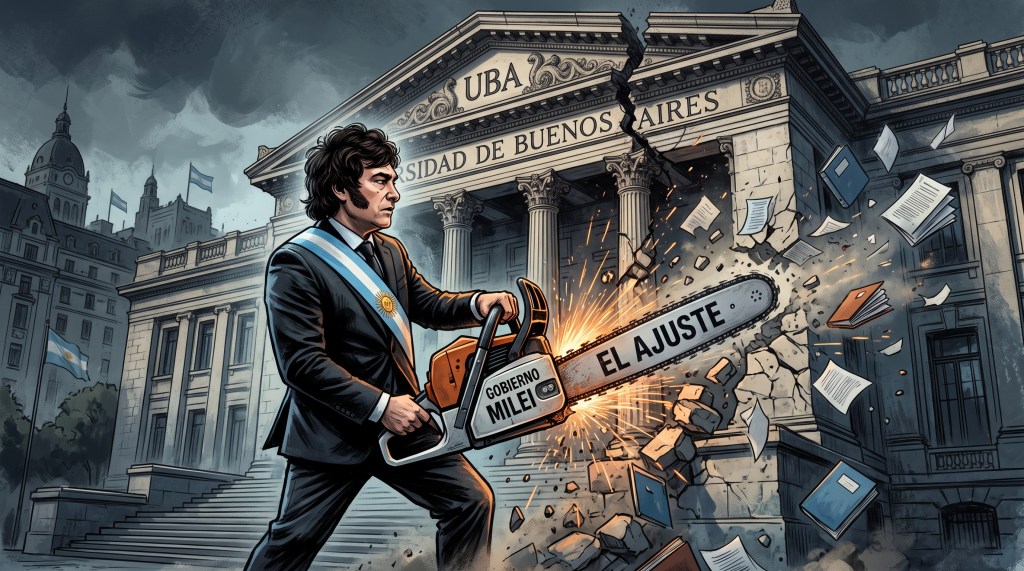
To witness the physical death of an ideological illusion, walk through the Faculty of Exact and Natural Sciences at the University of Buenos Aires (UBA) after sundown.
In the corridors of Latin America’s most decorated public institution—the cradle of five Nobel laureates—the elevators sit dead in their shafts. The common-area lightbulbs have been unscrewed. In biology laboratories, doctoral researchers carefully wash and dry disposable cotton swabs so they can reuse them for tomorrow’s experiments. In stairwells, tenured professors grade midterms by the glow of their smartphone flashlights, teaching classes in unheated, darkened auditoriums because the university cannot pay its municipal electricity bills.
This is Argentine higher education under President Javier Milei’s radical fiscal shock therapy. Wielding his trademark motosierra (chainsaw), Milei froze university operational allocations, slashed funding for the national scientific agency (CONICET) by nearly 50 percent in real terms, and repeatedly vetoed the congressional Ley de Financiamiento Universitario.
In response, millions of professors, students, and citizens have repeatedly poured into the streets of Buenos Aires, Córdoba, and Rosario for massive Marchas Federales Universitarias. Clad in defensive white coats, carrying copies of constitutional charters, and chanting anti-austerity anthems outside the Casa Rosada and the National Congress, the marchers demand the restoration of the state treasury’s spigot. They invoke the sacred memory of the 1918 Reforma Universitaria de Córdoba, claiming they are defending the century-old Latin American model of public university “autonomy” and open-access, tuition-free higher learning (la universidad pública, gratuita y autónoma).
It is an undeniably tragic, impassioned spectacle. But beneath the romantic rhetoric of public resistance lies a brutal, unavoidable structural reality:
The darkened hallways of UBA do not prove that higher education needs a more generous president. They prove that the “autonomous” state university is, and has always been, an employer company town tied to vulnerable state politics and funding.
The Myth of the Córdoba Sanctuary
For more than a century, Latin American higher education has wrapped itself in the foundational myth of the 1918 Córdoba Reform.
According to this secular gospel, the public university is not an ordinary state agency; it is a self-governing republic of the mind. Governed by cogobierno (joint management by professors, students, and alumni) and insulated by autonomía universitaria, the campus is supposed to be an inviolable sanctuary—a sovereign redoubt where critical thought, scientific inquiry, and social emancipation flourish far beyond the reach of presidential authoritarianism or market predation.
It is a beautiful fairy tale. And it collapses the exact moment an aggressive political administration looks at the institutional balance sheet.
How can a university claim to be “autonomous” when 100 percent of its operating budget, utility bills, research equipment, and faculty salaries are wired at the discretion of the national Treasury?
The answer is simple: it isn’t autonomous. It never was.
An institution funded entirely by the state treasury is not an autonomous sanctuary of scholars; it is a ministerial branch office that has temporarily escaped administrative auditing.
In the terminology of Roman labor law, the university professor remains a subordinate state wage-laborer (locatio operarum). The rector is a political broker negotiating line items in budget annexes. And the university campus is a massive company town built on the sovereign territory of the state.
When an executive like Milei comes to power with a mandate to eradicate public expenditure, he does not have to send tanks to occupy the campus or dispatch censors to edit lecture notes. He simply does what any landlord does when he wants to evict an unwanted tenant: he stops paying the utility bills.
The Reality of Academic Proletarianization
Look past the heroic speeches at the Obelisk, and examine what this state dependency has done to the lived reality of Argentine scholarship.
Over seventy percent of university teachers and researchers across Argentina’s national university system now take home salaries that sit below the national poverty line. Top biomedical researchers at CONICET—scholars whose peer-reviewed publications compete in international journals—are taking shifts as ride-share drivers, food delivery couriers, or freelance electricians on weekends just to buy groceries.
Meanwhile, university rectors spend their days groveling before congressional budget committees, trading political favors, and warning that the entire system will be forced into operational liquidation within months.
The defenders of the status quo insist that the only solution is to march again. To take the streets a third, fourth, or fifth time. To plead with Congress to override the veto. To wait out the current government in the desperate hope that the next presidential election will install a benevolent patron-state that will once again shower the company town with printed currency.
Think about the sheer indignity of this posture.
The greatest scientific and intellectual minds of a nation are reduced to begging politicians for electricity. They are trapped in a perpetual cycle of political clientelism: favored and celebrated when populists are spending, starved and humiliated when fiscal austerity takes power, whether by personal political philosophy or global economic recession.
You cannot preserve academic freedom by begging your employer to be less cruel. The fundamental flaw is not the chainsaw; the fundamental flaw is that you allowed your entire professional existence to be chained to the tree.
Why the Brick-and-Mortar Campus Guarantees Vulnerability
Why is the Argentine public university so easy to suffocate?
Because the corporate-state institution (Universitas) is an enormous, centralized, capital-intensive machine that is merely a means to an end, not the end itself.
To teach history, philosophy, physics, or jurisprudence, the University of Buenos Aires operates hundreds of aging facilities across the federal capital. It has massive central heating systems, industrial elevators, security payrolls, administrative fleets, and thousands of non-instructional maintenance workers.
When inflation hits 200 percent and utility tariffs are deregulated, the university’s operational cost per square meter explodes. The institution finds itself spending millions of dollars just to keep the lights on and the roofs from leaking—monies that must be diverted directly from teaching materials, library subscriptions, and faculty salaries.
The physical compound is the state’s ultimate point of leverage. Because the classroom is locked inside a designated municipal building owned and powered by the government, the state can shut down higher education simply by refusing to adjust utility subsidies to inflation.
The academic has zero exit options. A professor of constitutional law cannot teach their students because the university building is dark, but owns the legal status to issue credits and degrees. A chemist cannot mentor their doctoral cohort because the institutional laboratory has no supplies.
The professor has been completely stripped of the means and credential value of their hard-won intellectual production.
The PSA Antidote: The Great Decoupling
The tragedy unfolding in Buenos Aires is the ultimate empirical proof that state-welfare higher education is just as fatally flawed as the financialized corporate model of the Anglosphere.
One turns education into private student debt; the other turns it into an unfunded political hostage.
The only authentic path to academic autonomy—real, material, untouchable autonomy—is The Great Decoupling and the establishment of The Professional Society of Academics (PSA).
What happens to Javier Milei’s chainsaw when we sever the pursuit of truth from the state company town?
1. Portable Licensure Destroys State Leverage
Why can a presidential veto reduce an Argentine scholar to an Uber driver?
Because the academic’s right to teach and validate learning is owned entirely by an institutional employer on a state payroll line. If the state freezes the payroll, the scholar ceases to exist as an economic agent.
Under the PSA, academic legitimacy is vested inalienably in the scholar through Portable Licensure:
- The right to teach, design rigorous curricula, and assess student mastery is issued and protected by an autonomous, professional Guild (Societas) of disciplinary peers.
- Neither Javier Milei, nor a university rector, nor a congressional budget committee holds legal jurisdiction over a scholar’s license.
- A government cannot fire an academic, freeze their professional authority, or shut down their practice, because the government no longer owns the credentialing machinery.
2. Parsimonious Practice Obliterates the Utility Trap
Why does UBA need billions in state subsidies just to teach seminars?
Because it is dragging the dead weight of an enormous, centralized real-estate empire.
Under the PSA principle of Parsimonious Practice, all of this bloated physical overhead is eliminated:
- Independent academic practitioners operate as sovereign firms of one.
- They do not need a multi-million-dollar faculty pavilion to convene an advanced seminar. They lease dignified, human-scaled spaces in municipal libraries, neighborhood cultural centers (centros culturales), civic meeting halls, or leased storefronts across the city.
- A licensed practitioner convenes small, rigorous cohorts of 10 to 20 students.
When learning is distributed into human-scaled civic nodes, the utility bill loses its power as an instrument of state terror. If an executive cuts power to a federal building, scholarship simply shifts across the street to a neighborhood cafe, an independent library, a civic cooperative, or local business hub. The academy becomes physically un-evictable because it is embedded throughout the community.
3. Direct Contracts and Citizen-Controlled Funding
The standard defense of the Argentine model is that “state funding protects the poor.”
In reality, the state-funded model forces the poor to subsidize a massive bureaucratic apparatus while leaving students with canceled classes and striking professors.
Under the PSA, higher education is funded through the Direct Contract:
- If society wishes to guarantee free education, the state does not dump billions into opaque institutional black holes run by political rectors.
- Instead, public funds are converted into Direct Educational Entitlements or higher education vouchers held directly by the citizen-student.
- The student contracts directly with the sovereign, licensed practitioner of their choice.
- Under Parsimonious Practice, the cost of delivering elite, small-seminar education plummets by at least 50 to 60 percent, as evinced by these PSA financial analyses: United States, Canada, United Kingdom, Australia, and Republic of Ecuador. The citizen-student exercises direct fiscal control of their education funding, and every single peso flows straight to the teacher who mentors them.
Even in a scenario of total state collapse where the government completely abandons funding, a sovereign practitioner operating under Parsimonious Practice can offer an intensive, high-rigor seminar directly to students for an accessible, community-scaled fee that bypasses the broken currency and the state apparatus entirely.
4. The Public Practice Record (PPR) Replaces the Rector’s Stamp
Under the legacy of monopolistic institutional employer-enrollers, students endure darkened classrooms and absent teachers because they need the state university’s official diploma at the end of five years.
Under the PSA, intellectual competence is inscribed transparently on the Public Practice Record (PPR)—an open, decentralized, immutable ledger:
- Rigor is calibrated through objective Course Difficulty Scores (CDS) and blind peer evaluations conducted across the professional Guild.
- A student’s mastery in organic chemistry, constitutional history, or economic theory is validated by the academic profession, not by a rubber stamp from a bankrupt rectorate in Buenos Aires.
Step Out of the Dark
To the professors and researchers of Argentina currently shivering in unheated lecture halls and marking exams by the light of their phones:
Stop marching on the Casa Rosada. Stop begging a political establishment that views you as an ideological parasite to be a more generous master.
The Córdoba Reformers of 1918 were right about the goal: higher education must be autonomous, free, and democratic. But they were tragically wrong about the vehicle. They built their temple inside the state’s house, and now the state has cut the power.
You do not need their concrete buildings to teach. You do not need their rectorates to certify your intellect. You do not need their permission to be a community of scholars.
Higher education does not live in an institutional light socket. It lives in the unmediated covenant between the teacher who knows the truth and the student who desires to learn it. It is time to leave the company town. It is time to execute a great decoupling, claim our Portable Licensure, and build the Professional Society of Academics.


Leave a Reply