Every admission cycle in Ecuador, a cruel digital ritual plays out across living rooms from the hills of Quito to the esteros of Guayaquil and the plazas of Cuenca.
Hundreds of thousands of eighteen-year-olds sit in front of computer monitors, refreshing the SENESCYT platform, their futures hanging on a centralized algorithm. Within seconds of the allocation round going live, the verdict flashes across the screen for the vast majority of applicants:
“No se le asignó un cupo.” (No seat assigned).
In an instant, aspirations of studying medicine, mechanical engineering, law, philosophy, or agronomy evaporate. In 2026, the arithmetic remains as brutal as ever: out of more than 400,000 registered secondary school graduates seeking entry into the public higher education system, the country’s thirty-one public universities and polytechnics can scramble together barely 130,000 to 140,000 seats (cupos).
The rest—over a quarter of a million young citizens in a single cycle—are tossed into the administrative dustbin. Some are condescendingly offered seats in short-cycle technical certificates for which they never applied. Others are pushed into predatory private institutions where high-interest tuition debts await them. Most are simply locked out, relegated to informal street economies or left to wait in despair for the next roll of the bureaucratic dice.
Now, pause and consider the towering legal hypocrisy behind this scene:
Under Article 356 of Ecuador’s celebrated 2008 Montecristi Constitution, undergraduate education in public universities is explicitly declared to be an inalienable, universal right, free of charge to all citizens (la gratuidad de la educación superior pública hasta el tercer nivel).
The state promised an open public door in “21st Century Socialism“. In reality, it built a digital hunger games, one played around the world wherever the university/college employer-enroller model holds its monopoly over the social good.
Every year, university rectors and government ministers take to the airwaves to perform the same hollow kabuki dance. Rectors claim they are overwhelmed by demographic pressure and demand hundreds of millions in additional state transfers to pour concrete for new lecture buildings. Ministers counter by demanding “fiscal responsibility” and preaching institutional efficiency.
Both sides are lying to the public. The “sin cupo” tragedy is not a failure of public goodwill, nor is it an unavoidable demographic reality.
It is the catastrophic, mathematically inevitable breakdown of the employer-enroller real-estate monopoly (Universitas).
The Concrete Bottleneck
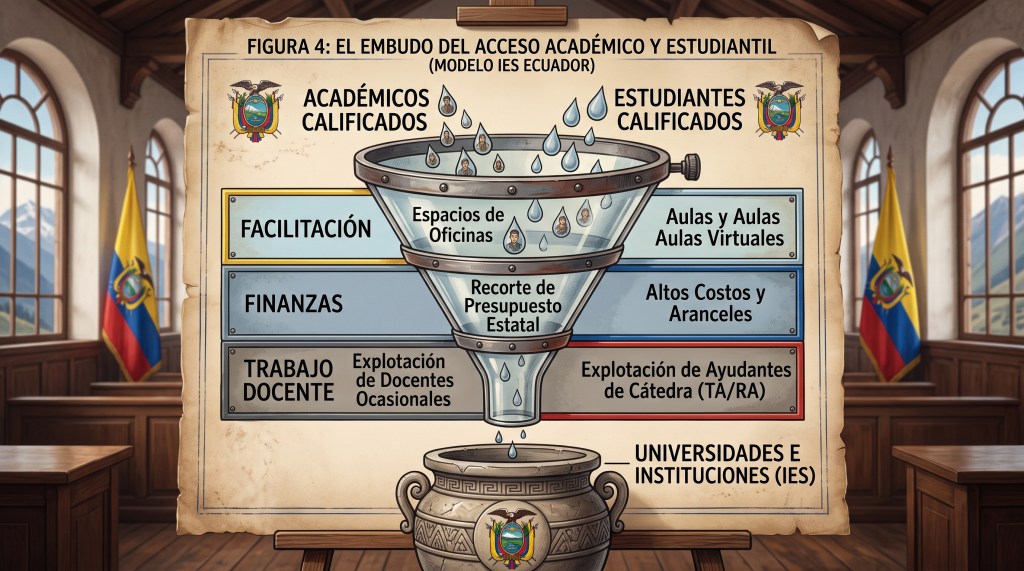
To understand why a quarter of a million young Ecuadorians are systematically denied education every year, you have to dissect the fundamental category error of institutional higher education: the conflation of higher learning with a physical real-estate compound.
Ask any university rector why they cannot admit the 250,000 rejected students, and they will give you an architectural excuse:
- “We don’t have enough physical classrooms.”
- “Our auditoriums are at maximum fire capacity.”
- “We lack the budget to construct a new five-story faculty pavilion.”
- “Our campus maintenance backlog exhausts our capital development funds.”
Listen carefully to what they are saying: education is being rationed because of a shortage of desks.
Think about the sheer, bankrupt absurdity of this premise.
Does Ecuador have a shortage of educated minds capable of teaching? Absolutely not. Across the country, thousands of brilliant scholars with master’s degrees and doctorates—many of them trained on public SENESCYT scholarships abroad—are underemployed, languishing in seasonal precarity as docentes ocasionales, or driving for ride-share apps because the institutional cartel has no open lines.
Does Ecuador have a shortage of eager minds ready to learn? The 400,000 applicants crashing the government servers prove the demand is overwhelming.
The minds are there. The teachers are there. The books, the datasets, the theorems, the knowledge, and the scientific methodologies are all available.
What stands between the scholar and the student? The concrete gate of the campus.
The institutional university (Universitas) insists that higher education cannot legally occur unless a student physically passes through a security checkpoint, sits in a chair owned by an accredited corporation, and registers on a centralized database managed by a sprawling rectorate.
Because the university is an immovable real-estate empire, every single student enrolled requires physical square footage, air conditioning, custodial staffing, security guards, utility infrastructure, and campus administration. And because building and maintaining that physical compound is ruinously expensive, the institution artificially bottlenecks enrollment to protect its balance sheet.
Constitutional gratuidad did not liberate higher education in Ecuador. By chaining free education to the physical limits of the legacy campus, it turned human intellectual development into an unfunded physical lottery.
The FOPEDEUPO Illusion: Where Does the $1.5 Billion Go?
Every time students protest in the streets over the lack of cupos, the university lobby points an accusing finger at the Ministerio de Economía y Finanzas in Quito, shouting that the national budget for higher education is starving them.
Let us look at the actual numbers:
In the national budget proformas, Ecuador allocates approximately $1.45 billion to $1.5 billion USD annually to public universities through the FOPEDEUPO (Fondo Permanente de Desarrollo Universitario y Politécnico) and direct Treasury compensations for gratuidad.
In a fully dollarized, developing economy, $1.5 billion is a staggering sum of public wealth.
If you divide that $1.45 billion by the 530,000 students currently enrolled across the public university sector, the state is spending approximately $2,735 per student per year.
Where does that money actually go? Does it go to the classroom? Does it go into the pocket of the professor teaching the seminar?
Hardly.
- Upwards of 60 to 70 percent of that budget is swallowed whole by the non-instructional apparatus: executive rectorates, politicized university councils, campus maintenance contracts, legal retainer fees, marketing divisions, and armies of administrative functionaries.
- Meanwhile, the frontline educators actually teaching the classes—including the 40% of the workforce trapped as docentes ocasionales—are paid seasonal piece-wages on six-month contracts, with delayed paychecks and zero job security.
The corporate university acts as an extractive tollbooth. It captures $1.5 billion in public tax dollars, burns two-thirds of it keeping an obsolete administrative and physical machine running, hands crumbs to its contingent teachers, and then tells 260,000 young citizens: “Lo sentimos, no hay cupos.”
The state does not have an educational funding crisis. It has an institutional landlord crisis.
The Technocratic Farce: From SNNA to “Autonomy”
For fifteen years, the Ecuadorian political establishment tried to solve this crisis using bureaucratic tinkering, and every single iteration failed, while the public cost of higher education beaurocracy went up:
- The Centralized Panopticon (The Correa Era): First, they built a massive centralized apparatus—the SNNA exam and SENESCYT assignment algorithms. A high school graduate in Esmeraldas who wanted to study engineering was told by a computer program in Quito that their only available cupo was in forestry in Loja, hundreds of miles away. It replaced local reality with Gosplan-style central planning.
- The “Decentralized” Wash (The Post-2022 Reforms): When the public revolted against the algorithm, the state passed the buck back to the individual universities, telling each campus to design its own entrance exams under the guise of “university autonomy.”
Did this create more seats? Of course not.
Instead of one centralized website crashing, applicants were forced to navigate thirty-one different broken university portals, pay clandestine “registration fees,” and stand in physical lines wrapping around campus blocks in Cuenca and Guayaquil. The physical bottleneck remained identical, because the number of desks had not changed.
You cannot solve a spatial and institutional monopoly by tweaking the admissions test. The test exists for one reason only: to act as an administrative bouncer, rationing scarce seats inside an inherently limited real-estate enclosure.
The PSA Antidote: The Great Decoupling
The “sin cupo” catastrophe will continue to claim the futures of hundreds of thousands of young Ecuadorians until we dismantle the structural root of the bottleneck: the bundled employer-enroller institution.
The Professional Society of Academics (PSA) offers the only permanent, structural exit ramp through a Great Decoupling.
We must separate higher education from the real-estate compound, the politicized rectorates, and the ministerial testing bureaus.
Here is how the PSA model eradicates the cupo crisis overnight:
1. Direct Public Vouchers Replace Institutional Block Grants
Under the PSA, the state ceases dumping $1.5 billion into institutional black holes.
Instead, the constitutional guarantee of Article 356 is realized directly through Direct Public Vouchers vested inalienably in the citizen-student.
- Every qualifying Ecuadorian student—that’s the 530,000 included, plus the 250,000 excluded—receives an annual higher education voucher, which based on current spending per student amounts to $1,290/year—fully funded by the existing FOPEDEUPO tax revenues.
- The citizen-student holds the purse strings. Through the Direct Contract, the student contracts directly with the sovereign, licensed academic practitioner of their choice.
- The corruptible administrative tollbooth is bypassed entirely. The money flows straight from the public treasury to the student, and from the student to the frontline educator.
2. Parsimonious Practice Obliterates the Spatial Bottleneck
Why must higher learning take place inside an overcrowded, multi-million-dollar campus compound? It doesn’t.
Under the PSA principle of Parsimonious Practice, independent academic practitioners operate as sovereign firms of one under Portable Licensure:
- Scholars do not beg a dean for a lecture hall. They lease dignified, accessible seminar spaces in municipal libraries, public civic centres, Casas de la Cultura, or local commercial coworking hubs across every canton in Ecuador.
- In a system where all 780,000 citizen-students have access to the constitutionally protected right of higher education, students taking a standard full-time load of eight courses a year pay an aggregate, publicly vouchered tuition of $1,290.
- A licensed practitioner convenes seminars charging an accessible fee of roughly $160 per student per course.
Look at what happens to systemic capacity: the physical bottleneck dissolves instantly.
The system suddenly generates capacity for hundreds of thousands of new students—without the state having to pour a single cubic metre of concrete or issue a single municipal bond. Higher education expands organically to wherever there is a teacher, a group of students, and a quiet room with internet access.
[For a video that explains how PSA can be embedded in the community see: https://vimeo.com/20320782]
3. Portable Licensure Liberates the Underemployed Scholar
The tragedy of the docente ocasional and the tragedy of the rejected estudiante sin cupo are two halves of the exact same institutional crime.
The corporate university starves the scholar of a permanent job while starving the student of a seat.
Under the PSA, accreditation is stripped away from the physical building and placed inalienably in the scholar through Portable Licensure, certified by an autonomous, horizontal Guild (Societas) of disciplinary peers:
- Qualified scholars no longer wait around for a rector to grant them a precarious six-month contract. They launch their own sovereign public practices.
- A sovereign scholar in Ecuador managing an annual roster of (say) 250 students, each paying $160 with their state vouchers, produces a gross professionally licensed practice revenue of $40,000. With annual practice overhead estimated at a generous $15,000, covering all practice facilities and a fully funded graduate teaching assistant, that’s net income of $25,000. According to data from the national statistics institute, this is nearly twice the average total household income (often combining multiple family earners) which sits at $1,135 a month (~$13,620 a year).
- As this PSA financial analysis for Ecuador shows, scholars earn a dignified, upper-class living; the graduate assistant earns a living wage; and the student gets intensive instruction.
4. The Public Practice Record (PPR) Replaces the SENESCYT Bouncer
How do we maintain rigor without an institutional accreditation board like CACES or an entrance exam run by SENESCYT?
Through the Public Practice Record (PPR):
- A student’s intellectual progress is not documented on an opaque university transcript that can be manipulated by rectorate grade inflation; it is inscribed on an open, immutable, decentralized public ledger.
- Course rigor is calibrated through transparent Course Difficulty Scores (CDS) and blind, post-completion peer evaluation conducted by the professional Guild.
- Admissions ceases to be a bureaucratic lottery run by a server in Quito; it becomes a process of Mutual Selectivity between the sovereign master and the aspiring apprentice.
Tear Down the Turnstiles
To the 250,000 Ecuadorian high school graduates staring in heartbreak at their computer screens this week, told by an algorithm that there is “no room” for their minds:
Do not internalize the lie that you were not smart enough, or that your country is too poor to educate you.
Your country has the money. The professors have the knowledge. You were locked out because the people running higher education are protecting a real-estate cartel and a patronage network that cannot function without rationing.
The true university is not a gated campus with armed guards, a political rectorate, and an overcrowded lecture hall. The true university is the sovereign encounter between a teacher who knows the truth and a student who seeks it.
It is time to abolish the lottery. It is time to execute a Great Decoupling, dismantle the physical turnstiles, and build the Professional Society of Academics.


Leave a Reply