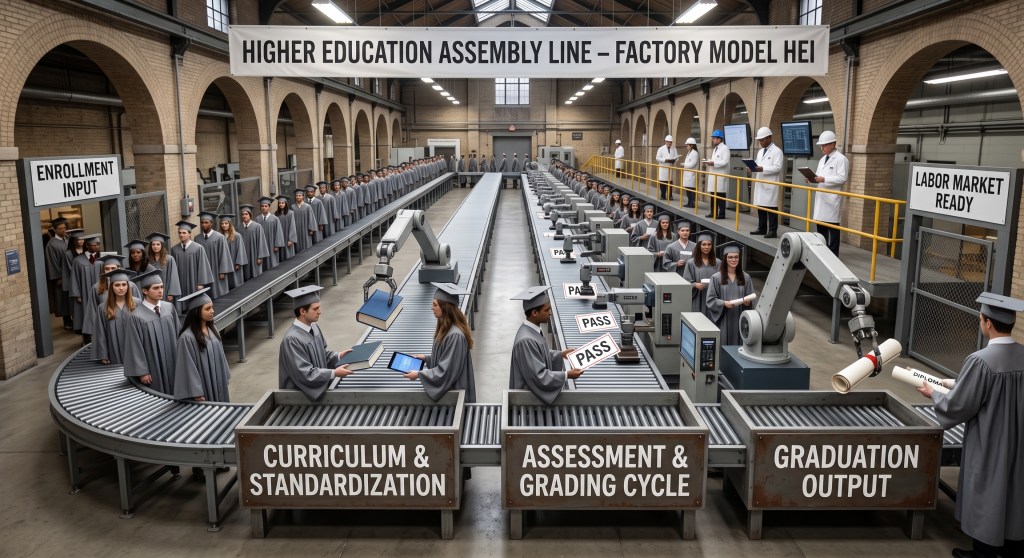
If you want to observe what happens when a modern European state decides to drop the pretense of the “knowledge economy” and run higher education like a 19th-century meatpacking plant, look at the Netherlands.
Over the past year, Dutch campuses have been engulfed in open revolt. Tens of thousands of students and faculty poured onto the Malieveld in The Hague and staged rolling walkouts from the Vrije Universiteit in Amsterdam to Erasmus in Rotterdam and Twente. They are protesting what Dutch academia has aptly christened the “Eppocalypse“—an unprecedented €1.2-billion austerity package pushed through by the right-wing coalition and Education Minister Eppo Bruins.
The cuts are brutal: scrapping start-up and incentive grants for early-career researchers, gutting scientific budgets, and forcing universities to slash English-taught degree tracks under aggressive language mandates.
Yet the spiritual centerpiece of the Dutch state’s crusade against higher learning is a policy so cartoonishly philistine that it sounds like satire: the resurrection of the langstudeerboete (the “long-study fine”).
Under this mechanism, any student who takes more than a single year beyond the nominal completion time for their bachelor’s or master’s degree is slapped with an automatic €3,000 annual surcharge on top of their regular tuition. Simultaneously, university administrations face structural funding penalties if they fail to expel or graduate their student cohorts on schedule.
University presidents and student unions have denounced the policy as cruel, short-sighted, and an attack on accessibility.
It is all of those things. But it is also something much worse: it is the final, unvarnished triumph of Taylorism in the lecture hall.
The Student as Unfinished Inventory
To understand the langstudeerboete, you have to understand how the corporate-state university (Universitas) views human beings.
In the bureaucratic imagination of The Hague, an eighteen-year-old entering a university is not a sovereign citizen embarking on an open-ended, transformational engagement with the human knowledge commons. The student is an unbilled inventory unit on an industrial conveyor belt.
- The curriculum is the assembly sequence.
- The lecture hall is the fabrication floor.
- The professor is a salaried foreman (locatio operarum) tasked with installing standardized cognitive components within a mandated number of billable minutes.
If an inquisitive student pauses on the assembly line—say, to teach themselves ancient Greek, conduct extra replications in an organic chemistry lab, switch concentrations after discovering an unexpected intellectual passion, or manage a chronic illness or family crisis—the factory manager panics.
Why? Because a student who lingers is occupying publicly expensive floor space without generating a high-speed exit subsidy. They are slowing down the plant’s throughput volume.
So the state reaches for the industrial speed-up. It fines the student €3,000 for wasting the factory’s time, while threatening the university with clawbacks if it doesn’t push the defective, slow-moving inventory out the loading dock.
The student union LSVb correctly pointed out that the government is treating students as an institutional ATM. But the deeper tragedy is metaphysical: the state has officially codified the doctrine that thinking takes too long, and curiosity is a billable offense.
The English Cull: Parochialism Meets the Balance Sheet
The absurdity of the long-study penalty is matched only by the Dutch government’s simultaneous war on internationalization.
For twenty years, Dutch universities aggressively marketed themselves as the cosmopolitan vanguard of continental Europe. They transformed campuses like Maastricht, Groningen, and Amsterdam into multilingual crossroads, launching dozens of English-taught bachelor’s programs and recruiting celebrated international scholars.
They did this, of course, because international students were a lucrative revenue stream.
Now, under populist political pressure to curb immigration and appease nationalist anxieties, Minister Bruins and the coalition have enacted the “Internationalisation in Balance” directives. Bachelor’s degrees must revert to two-thirds Dutch instruction, English tracks are being subjected to ministerial elimination, and international recruitment is being choked off.
And who pays the price for this political pivot?
The non-Dutch-speaking researchers and contract lecturers who were recruited to the Netherlands under promises of a borderless European academy. Entire international research teams are being dismantled, non-tenured foreign staff are being shown the door, and Dutch universities—which once bragged about dominating the top of global research rankings—are preparing for mass redundancies.
The message from the Dutch state is unmistakable: When we needed you to balance our spreadsheets, we welcomed you. Now that the political wind has shifted, you are an administrative nuisance.
The Trap of the Benevolent Patron
Faced with this dual assault, what is the strategy of the Dutch academic establishment?
The umbrella organization Universities of the Netherlands (UNL) and academic activist groups like WOinActie organize marches, wave protest signs saying “Don’t Do It,” and file lawsuits. They remind the cabinet that cutting a billion euros is the equivalent of closing three entire universities. They plead with parliament to remember that the Netherlands is supposed to be a “top knowledge economy.”
It is a heartbreaking display of institutional impotence fueled by ignorant assumption.
The Dutch professoriate is discovering the hard way what American and British academics learned years ago: an institution funded entirely by the state treasury is never autonomous; it is merely a ministerial bureau that has not yet been downsized.
When you operate as an employee on a state payroll within a state-chartered corporation, your “academic freedom” exists only at the pleasure of the governing majority. If parliament decides that higher education should be converted into a Dutch-only technical trade pipeline with an industrial clock, the university council has zero legal sovereignty to stop them.
You cannot preserve intellectual freedom by marching on the ministry and begging the master to be a more generous patron. As long as the physical campus, the degree credential, and the academic payroll are enclosed within the machinery of the state, the state will always dictate the terms of the assembly line.
The PSA Remedy: The Great Decoupling
The “Eppocalypse” proves that neither the corporate market model of the Anglosphere nor the state-welfare model of continental Europe can protect the integrity of higher learning. Both reduce education to an extractive commodity—one to private debt, the other to bureaucratic throughput.
The only structural escape route is a Great Decoupling and the establishment of The Professional Society of Academics (PSA).
What happens to the intellectual assembly line when we liberate the profession (Societas) from the state-chartered institution (Universitas)?
1. The Public Practice Record (PPR) Replaces the Factory Clock
Why does the Dutch state need a langstudeerboete? Because inside the legacy system, academic achievement is measured by bureaucratic seat-time: credit hours accumulated within rigid calendar semesters.
Under the PSA, learning is completely decoupled from artificial calendar clocks.
- Intellectual rigor and student achievement are verified through the Public Practice Record (PPR) ledger.
- A student’s mastery is not evaluated by an attendance sheet or an automated administrative deadline; it is assessed through transparent, objective peer evaluation and Course Difficulty Scores (CDS) conducted across the Guild.
- If a student masters advanced mathematical physics in two months, their competence is inscribed on the open ledger. If a student needs eighteen months of deep, contemplative study, independent replication, and archival work to master a subject, they take eighteen months.
No fines. No administrative speed-ups. No bureaucratic stopwatch. Rigor is measured by genuine understanding, not factory throughput.
2. The Direct Contract: Citizen-Student Control and a 50% Cut in Public Cost
The entire justification for Minister Bruins’s €1.2-billion austerity package and the punitive €3,000 fine is the state’s claim that public higher education is an unsustainable fiscal burden on the treasury.
Why is it an unsustainable burden? Because under the institutional monopoly, the state does not pay for education; it pays for the real-estate and administrative empire of the university.
Between 60 and 75 percent of every euro the Dutch state sends to a university never touches a classroom. It is swallowed by facilities depreciation, campus bond debt, armies of administrative coordinators, marketing divisions, executive salaries, and campus real-estate speculation. The state pays upwards of €12,000 to €18,000 per student per year in public subsidies, yet the student still faces tuition fees, overcrowded 300-person auditoriums, and a €3,000 fine if they take an extra term to think.
The PSA obliterates this entire middleman apparatus through the Direct Contract:
- Democratizing Public Expenditure: Instead of funneling billions in opaque block grants into institutional black holes, the state’s higher education budget is converted into direct educational entitlements vested directly in the citizen-student.
- The Student Controls the Purse Strings: The citizen-student holds the public educational allocation in their own hands. Through the Direct Contract, the student contracts directly with the sovereign, licensed academic practitioner of their choice. If an instructor is mediocre or an institution is corrupt, the student doesn’t have to plead with a dean; they take their contract elsewhere. The citizen-student—not a ministry bureaucrat, a corporate board, or a university council—exercises direct, democratic fiscal control over public higher education spending.
- Slashing Public Costs by at Least 50%: Under the PSA principle of Parsimonious Practice, all the non-instructional corporate fat is eliminated. A sovereign scholar operates as an independent firm of one, leasing seminar space in municipal libraries, public civic centres, or downtown cultural hubs.
- An intensive, small-cohort seminar of 10 to 12 students costs only €800 to €1,000 per student.
- A full academic year of comprehensive, elite, face-to-face instruction across eight rigorous seminars requires an aggregate expenditure of only €6,400 to €8,000 per student.
- Even when fully funded by the state entitlement, the total public cost to the taxpayer drops by at least 50 to 60 percent compared to legacy institutional allocations.
The fiscal math is incontrovertible: the state saves billions in public expenditure overnight, the student pays zero out-of-pocket tuition and zero predatory fines, and the sovereign scholar earns a secure, dignified professional income of €80,000 to €120,000 for teaching small, intimate cohorts.
The entire premise of the “Eppocalypse”—that public spending must be choked and students fined to balance the national budget—collapses the second you remove the institutional landlord from the transaction.
See these PSA Blog post for full financial analysis of the professional model: United States, Canada, Australia.
3. Portable Licensure Defeats State Parochialism
The tragic purge of international scholars across Dutch universities is possible only because an academic’s right to teach is chained to an institutional employer’s contract.
Under the PSA, academic legitimacy is vested inalienably in the scholar through Portable Licensure:
- A scholar’s authority to teach, research, and validate credit is certified by an autonomous, professional Guild of disciplinary peers, completely independent of national borders or ministerial decrees.
- If a reactionary parliament decides to outlaw seminars taught in English, French, or German, it has zero jurisdiction over a sovereign practitioner’s license or how citizen-students spend their higher education tax dollars.
- Scholars across Europe and the globe can teach in the languages of their disciplines, forming direct cohorts with local and international students who seek authentic intellectual breadth, insulated from the nationalist culture wars of domestic politics.
Step Off the Conveyor Belt
To the students and professors across the Netherlands currently marching against Minister Bruins and facing down the langstudeerboete:
The state is not going to suddenly rediscover the ideals of Erasmus or Spinoza. The Dutch cabinet did not make a mathematical error; it looked at the university and decided it wanted a vocational factory that runs on time and balances the budget.
Stop pleading with the politicians to slow down the assembly line.
Higher learning is not a manufacturing process, and students are not raw materials to be hurried through a stamping press under threat of a fine. True scholarship is contemplative, rigorous, unpredictable, and free. It is time to leave the factory floor. It is time to execute a Great Decoupling, claim our Portable Licensure, and build the Professional Society of Academics.


Leave a comment