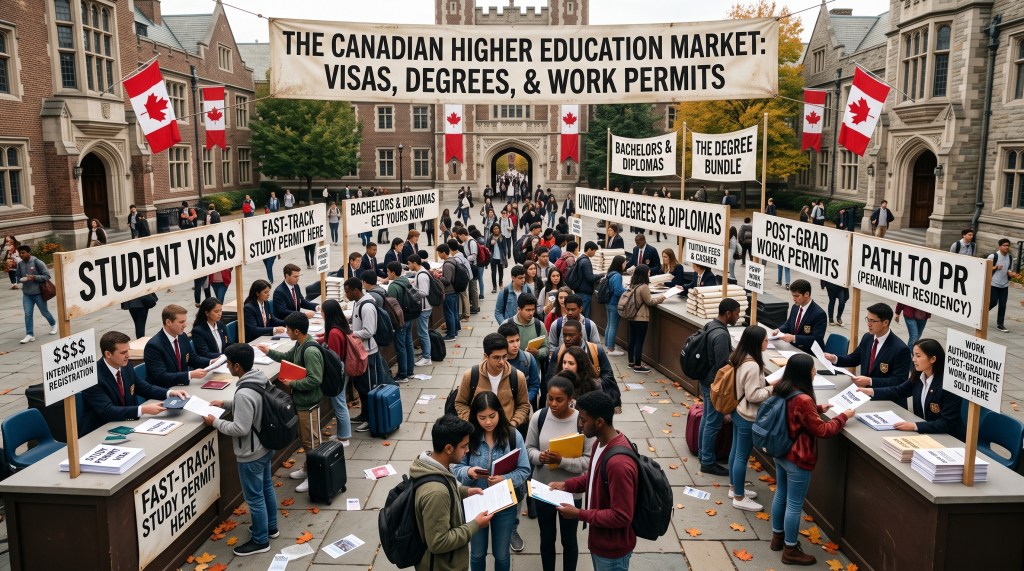
If you want to watch an entire national industry suffer a sudden, violent identity crisis, take a tour of Canadian higher education this autumn.
For the past decade, Canadian university presidents and college executives walked around with the smug, self-satisfied aura of visionary global entrepreneurs. They were celebrated in Ottawa and provincial legislatures as titans of an economic miracle: turning “brand Canada” into the premier global destination for higher learning, while quietly boasting about record operating surpluses, brand-new campus real-estate developments, and surging international enrollments.
Then, the federal government looked at the nationwide housing crisis, checked the immigration numbers, and finally pulled the emergency brake.
Between early 2024 and late 2026, Immigration, Refugees and Citizenship Canada (IRCC) methodically squeezed the study permit spigot, driving the total population of international permit holders down from a peak of more than one million to under 700,000, while slashing the target for new arrivals down to 155,000.
Almost overnight, the fairy tale suffered a catastrophic, humiliating collapse.
Across Ontario, British Columbia, and Atlantic Canada, campuses are in outright financial freefall. Suburban community colleges that grew fat on two-year business diplomas are staring at nine-figure balance-sheet craters. Flagship research universities like Queen’s and York are enacting emergency hiring freezes, slashing instructional budgets, cancelling graduate admissions lines, and warning of structural deficits. In British Columbia—where international student tuition had quietly grown to comprise over 60 percent of all tuition revenue—provosts are running around with budget shears, chopping course sections and shutting down satellite facilities.
University presidents are writing panic-stricken op-eds, lobbying ministers, and begging the public to understand that their institutions are facing “unprecedented existential jeopardy.”
It is a stunning spectacle. But before anyone sheds a tear for the beleaguered Canadian academy, we need to name the material reality for what it is:
Canadian higher education was never an educational system. It was a predatory immigration brokerage with a campus attached—and the arbitrage scheme just broke.
The Architecture of the Great Northern Grift
To understand how Canadian higher ed ended up in the emergency ward, you have to look at the cynical pact made between provincial governments and institutional executives over the last fifteen years.
Beginning in the 2010s, provincial governments—most notably in Ontario under both Liberal and Conservative premierships—decided they wanted a world-class postsecondary sector without actually paying for it. Queen’s Park froze domestic tuition fees and let per-student operating grants wither into the lowest per-capita subsidies in the country.
Did university and college boards of governors revolt? Did they downsize their executive suites or challenge provincial disinvestment?
Of course not. That’s not how the corporate university (Universitas) operates.
Instead, provincial ministries gave institutional leaders a knowing wink and a deregulation pass: We won’t fund you, but we will let you charge uncapped, unregulated differential tuition to international students. Go wild.
And go wild they did.
The corporate campus realized it possessed an extraordinary, state-backed monopoly: the Designated Learning Institution (DLI) credential. In Canada, an enrollment letter from an accredited DLI was not merely an admission to a classroom; it was the golden ticket to a Post-Graduation Work Permit (PGWP)—the primary regulatory pipeline into Canadian permanent residency.
Canadian colleges and universities stopped acting like institutions of higher learning and started acting like speculative visa cartels:
- They dispatched armies of third-party recruitment agents to Punjab, Gujarat, Lagos, and East Asia, selling eighteen-year-olds dreams of Canadian immigration.
- They charged these students $30,000, $45,000, or $60,000 a year—four to six times the domestic tuition rate for the exact same seat.
- Suburban community colleges set up strip-mall satellite campuses in downtown Toronto office buildings, stuffing thousands of international students into low-overhead diploma programs that existed almost exclusively to mint PGWP eligibility.
- Historic flagships weren’t above the racket either; they simply dressed it up with gothic architecture, using massive international tuition premiums to finance commercial bond debt, build administrative towers, and subsidize $500,000 presidential compensation packages.
By 2024, international students were supplying over half of all university tuition revenue in Ontario. The entire sector had become a volume-driven, human-trafficking commodity market disguised as a knowledge economy.
The Landlord’s Playbook: Throwing the Teachers Overboard
The fatal flaw of building a business model on regulatory arbitrage is that regulations change.
When the federal government finally acknowledged that importing a million temporary residents into a country with a severe urban housing shortage was a recipe for civic disaster, Ottawa capped study permits, cracked down on non-degree work permits, and demanded institutional compliance data.
The gravy train ground to a screeching halt.
And now that the foreign tuition pipeline has dried up, who is being forced to pay for the hangover?
Is it the university presidents who took multi-million-dollar bonuses for inflating enrollments? Are the corporate boards of governors renegotiating their commercial real-estate debts or dismantling their bloated vice-provostial empires?
Don’t be naive. In the employer-employee hierarchy of the corporate university (locatio operarum), the frontline worker always absorbs the landlord’s loss.
Universities and colleges are staging a nationwide purge:
- The Sessional Cull: Contract faculty, adjuncts, and graduate teaching assistants—who deliver the vast majority of introductory undergraduate courses—are having their contracts terminated with a week’s notice.
- Curricular Scorched-Earth: Departments in modern languages, philosophy, gender studies, classics, and environmental humanities are being marked for elimination because corporate spreadsheets deem them “non-revenue-generating.”
- The Lecture Hall Crush: Remaining full-time and tenured faculty are ordered to absorb massive class expansions, grading hundreds of papers with zero TA support while teaching in poorly maintained, decaying lecture halls.
The executives who gambled the public university on a volatile immigration loop are sitting comfortably in their mahogany boardrooms, declaring “financial exigency” and lecturing the faculty on the need for “shared sacrifice.”
Why Does Teaching Require a Visa Cartel?
The Canadian crisis exposes the foundational lie of the institutional higher education model: the unexamined myth that higher learning cannot happen without an employer-enroller real-estate corporation.
Step back and look at the sheer absurdity of the equation:
Why should the existence of an advanced seminar on Canadian constitutional law, indigenous history, quantum mechanics, or French literature in Kingston or Vancouver depend on whether the federal immigration minister approves study visas for master’s students in project management?
What on earth does the teaching of biochemistry have to do with whether an institution can sell work permits to international undergrads?
The answer is: nothing.
A scholar does not need an international visa arbitrage scheme to teach. A student does not need an institutional real-estate conglomerate carrying hundreds of millions in commercial debt to learn.
The only entity that needs that money is the corporate middleman.
The university (Universitas) operates as an extractive tollbooth standing between the scholar and the student. It skims 80 percent of the tuition off the top to feed its managerial apparatus, marketing consultants, recruitment agents, and physical monuments. And the moment that 80 percent markup isn’t covered by foreign cash flows, the landlord cancels the education and locks the doors.
The PSA Antidote: The Great Decoupling
The financial wreckage across Canadian campuses is not a temporary dip in the business cycle. It is the definitive proof that the institutional model is spiritually and materially bankrupt. Begging provincial premiers for an emergency taxpayer bailout just to keep insolvent university administrations on life support is throwing public funds into a bottomless pit.
The only permanent escape for Canadian academics and learners is a Great Decoupling and the establishment of The Professional Society of Academics (PSA).
Imagine how higher education functions when you strip away the corporate campus and the visa racket:
1. Portable Licensure Destroys the Institutional Monopoly
Under the legacy Canadian model, the authority to teach and grant academic credit is tied permanently to a state-chartered, DLI-accredited building. If the university cuts your department or goes into receivership, your professional capacity to contribute to and earn in higher education is extinguished.
Under the PSA, accreditation is decoupled from the physical institution.
- Academic legitimacy is vested inalienably in the scholar through Portable Licensure, certified by an autonomous, professional Guild (Societas) of disciplinary peers.
- The right to teach, design rigorous curricula, and assess student mastery belongs to the scholar, not to a board of governors or a provincial ministry.
- A university cannot hold your career hostage, because they do not own your license to practice higher education.
2. Parsimonious Practice Replaces Corporate Overhead
Why do Canadian universities charge international students $40,000 and domestic students $8,000, while still crying poverty?
Because they are paying for real-estate bond debt, athletic complexes, legal retainers, marketing divisions, and armies of deans.
Under the PSA principle of Parsimonious Practice, all of this non-instructional waste is eliminated:
- Independent academic practitioners operate as sovereign firms of one, leasing seminar spaces on public campuses, in municipal public libraries, local civic centres, or leased downtown storefronts.
- Through the Direct Contract, a student pays an accessible, humane fee (e.g., $1,000 per course) directly to the licensed scholar.
- A practitioner teaching two small, intimate seminars of 12 students earns $24,000 for a single semester’s work—flowing 100 percent to the teacher, while students receive elite, face-to-face mentorship for a fraction of corporate tuition.
Without the crushing overhead of a multi-billion-dollar campus compound, higher education becomes entirely self-sustaining on local, human-scale resources. It requires zero government debt, zero tuition extortion, and zero foreign-student cash subsidies. With the substantial cost reductions of PSA, higher education can finally be tuition-free or even expense-free.
3. Real International Education Replaces the Visa Scam
Decoupling higher education from institutional campuses ends the cynical exploitation of international learners once and for all.
Under the PSA, an international student is not a walking cash cow harvested to plug an institutional deficit.
- Through distributed local nodes and digital seminars, international students can study directly with world-class Canadian and global scholars from anywhere in the world—or within Canada as independent adult learners—without being trapped in predatory, multi-thousand-dollar tuition schemes.
- Academic rigor is evaluated objectively through the Public Practice Record (PPR) ledger, governed by blind peer evaluation across the transnational Guild, obliterating the corrupt “customer satisfaction” grade inflation that corporate administrations use to protect international enrollment revenue.
Higher learning ceases to be a speculative backdoor into the labor market and returns to being what it was always meant to be: an unmediated, sovereign covenant of the mind.
Let the Mill Close
To the thousands of Canadian contract lecturers, sessional instructors, and early-career researchers currently staring at non-renewal notices and wondering how an entire university system could collapse in thirty-six months:
The university did not fail you because you didn’t work hard enough. It failed you because you were working inside a visa brokerage that masqueraded as an academy.
Stop marching outside administrative buildings begging provosts to spare your departments. Stop waiting for provincial governments to rescue an administrative machine that treats your labor as a disposable line item.
The knowledge does not live in their concrete buildings. The authority does not live in a DLI accreditation certificate. It lives in you.
It is time to execute a Great Decoupling. It is time to leave the company town, claim our Portable Licensure, and build the Professional Society of Academics.


Leave a comment