Whenever diplomatic tensions flare up between Western capitals and Beijing—whether over naval skirmishes in the South China Sea, semiconductor export bans, a sovereign Taiwan, or human rights reports—a very specific ritual plays out across the executive suites of Western higher education.
While defense analysts debate deterrence and foreign ministries issue stern communiqués, university provosts and chief financial officers from Sydney and Melbourne to London, Toronto, and the American Big Ten break out into a cold, clammy sweat.
The nightmare keeping these academic executives awake at night isn’t the threat of geopolitical conflict. It’s the terrifying prospect of a single, terse paragraph appearing on the website of China’s Ministry of Education: “Notice on Issuing Study Abroad Safety Warning No. 1.”
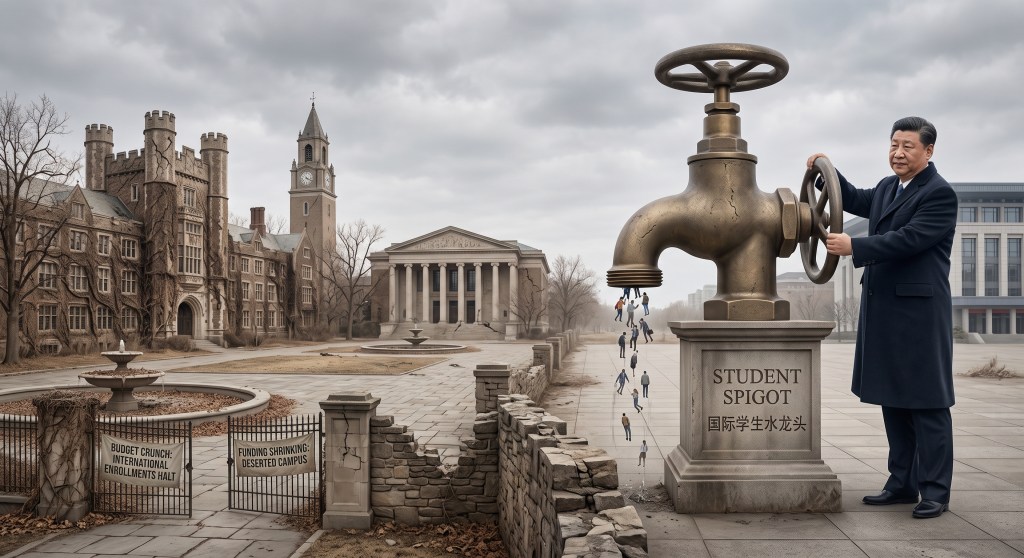
Every university administrator knows what that notice means. In the language of Beijing’s state-directed apparatus, a travel warning or an editorial in the Global Times targeting Western universities is the financial equivalent of turning off the main gas valve to a residential block in mid-January.
Within days of such announcements, student visa applications stall, state-approved educational brokers redirect applicant streams, and Western campuses face sudden, nine-figure craters in their operating budgets.
And so, like clockwork, the corporate university (Universitas) shifts into aggressive, groveling damage control. Sensitive campus events are quietly cancelled. Visiting dissident scholars are relegated to basement seminar rooms or denied platform space. Faculty members teaching contemporary East Asian politics receive “collegial guidance” from department chairs suggesting they remove sensitive readings from syllabi to avoid “complications” for students connecting via overseas VPNs.
Western universities spend hundreds of millions of dollars branding themselves as fearless citadels of liberal democracy, intellectual courage, and human rights. But look at their balance sheets for five minutes, and the truth becomes unmistakable: the corporate campus cannot afford an ethical foreign policy.
The Anatomy of an Academic Cash Addiction
To understand why a Western provost gets palpitations every time Chinese state media sneezes, you have to look at the financial architecture of the modern higher education institution.
Over the past twenty-five years, universities and colleges across the Anglosphere made a calculated, Faustian bargain. As domestic state subsidies declined and tuition caps were reached, campus leadership did not trim administrative payrolls, downsize real-estate ambitions, or rethink their capital models.
Instead, they discovered the ultimate corporate cross-subsidy: the full-fee-paying international student.
Unlike domestic students, whose tuition is often capped by statutory limits, international students can be milked for whatever the global luxury market will bear. Institutions began charging overseas students $40,000, $60,000, or £38,000 a year for standard undergraduate degrees and one-year taught master’s programs—three to four times what domestic peers pay for the exact same seat.
And no market was more lucrative, or more aggressively pursued, than mainland China.
Western universities didn’t just recruit in China; they built entire institutional business models around Chinese enrollment pipelines:
- In Australia, the elite “Group of Eight” (Go8) universities turned international education into the country’s fourth-largest export industry, with institutions like the University of Sydney relying on Chinese student fees for up to a quarter of their entire operating revenue.
- In the UK, dozens of Russell Group and post-92 universities used Chinese tuition flows to finance massive expansions of commercial bond debt, servicing brand-new business school atriums and paying £450,000 vice-chancellor salaries.
- In the United States, public flagships like Ohio State, Illinois, and Indiana enrolled thousands of Chinese undergraduates to plug holes left by legislative disinvestment, using foreign cash to subsidize multi-million-dollar athletic coaching contracts and campus amenities.
This was never an altruistic program of “global intellectual and cultural exchange.” It was a volume-driven financial extraction scheme. The corporate university treated Chinese students as walking tuition bonds—commodities to be harvested to keep the campus real-estate casino solvent.
The Bouncer Behind the Lectern
The fatal flaw of building a business model on an international cash cow is that every financial dependency is also a political leash. And unlike Western university boards, the Chinese Communist Party understands leverage.
When an institution relies on a single foreign market for 15 to 25 percent of its operational budget, that institution ceases to be a sovereign intellectual entity. It becomes an economic hostage.
Consider what this hostage status actually looks like in practice:
- The Transnational Gag Order: When pro-democracy demonstrations or human rights panels are organized on Western campuses, university administrations routinely intervene to de-escalate, relocate, or cancel them, citing “security concerns” or “community harmony.” What they actually fear is a viral video on Weibo that prompts a consumer boycott or a ministerial penalty.
- Complicity in Surveillance: For years, investigative reports from Australia, Canada, the US, and the UK have documented the active intimidation of Chinese dissident students and diaspora communities on Western campuses by state-aligned student associations and consular networks. Instead of aggressively expelling operatives and protecting vulnerable students, university administrators routinely look the other way. Protecting individual students would mean confronting the diplomatic network that feeds the institutional revenue trough.
- The Preemptive Classroom Chill: Faculty members teaching political science, history, or international relations are left entirely unprotected. When corporate administrators prioritize enrollment yields over disciplinary integrity, professors face quiet administrative pressure to avoid “divisive” topics that might offend full-fee-paying cohorts or trigger diplomatic friction.
The Western university claims to be an open public square. In reality, it operates like a luxury hotel chain operating under a foreign franchise agreement. The moment the paying guests or their home government complain about the decor in the lobby, the manager rushes out to take down the art.
The Trap of the Employer-Enroller Monopoly
The establishment’s standard response to this crisis is pure institutional hand-wringing. Pundits and parliamentary committees call for “diversifying recruitment streams”—which is simply corporate code for finding new international markets (like India, Vietnam, or Nigeria) to exploit with the same predatory markup.
Others demand federal subsidies to replace the lost foreign revenue, begging taxpayers to bail out university budgets so institutions don’t have to rely on Beijing.
Both proposals miss the core structural rot: the employer-enroller institution (Universitas) is structurally incapable of resisting geopolitical coercion.
Why can Beijing squeeze a university? Because the university is an enormous, centralized, debt-heavy corporation.
- It has $500-million bond issuances to service.
- It has armies of non-instructional vice chancellors, marketing directors, and international recruitment agents to pay.
- It has sprawling, inefficient physical campuses with billions of dollars in deferred maintenance backlogs.
When an organization carries that much overhead, it has zero moral stamina. It cannot stand on principle because standing on principle means immediate financial insolvency. The moment an authoritarian state threatens the cash flow, the corporate board of trustees will sacrifice the academic freedom of its faculty every single time.
As long as higher learning is enclosed inside a monopolistic corporate campus that operates as an employer-employee hierarchy (locatio operarum), scholars will remain subordinate factory workers whose intellectual and personal freedom is held hostage to their employer’s international marketing strategy.
The PSA Antidote: The Great Decoupling
The geopolitical hostage crisis on Western campuses cannot be resolved with better crisis-management consultants or broader recruitment brochures. It can only be resolved by The Great Decoupling.
The Professional Society of Academics (PSA) dismantles this entire extractive apparatus by severing the pursuit and protection of higher learning from the financialized corporate campus.
1. Parsimonious Practice Destroys the Cash Addiction
Why does a university need to charge a Chinese student $50,000 a year?
Not to pay the professor. The adjunct or lecturer teaching the course is lucky to see $4,000 for the semester. The remaining $46,000 is burned on campus administrative bloat, luxury real-estate debt, and corporate marketing budgets.
Under the PSA principle of Parsimonious Practice, all of this non-instructional fat is eliminated:
- Independent academic practitioners operate as sovereign firms of one or partnerships, leasing human-scaled seminar spaces in municipal libraries, civic hubs, or leased storefronts and public campus space.
- Because there is no real-estate empire or $850,000 presidential salary to subsidize, the cost of higher education plummets to human scale.
- A licensed scholar can offer an intensive, high-rigor seminar directly to students for an accessible $1,000 per person.
When higher education is delivered without institutional overhead, the university’s financial addiction to foreign cash disappears overnight. Western scholars no longer need an international tuition cross-subsidy to survive, because there is no value-extracting corporate landlord standing between them and their work.
2. Direct Contracts End the Exploitation of International Students
In the current system, international students from China are treated with cynical duplicity: prized as cash cows by financial officers, while simultaneously viewed with suspicion by intelligence agencies and isolated on campus by language barriers and corporate neglect.
Under the PSA, international education ceases to be an extractive immigration commodity.
- Through the Direct Contract, a student—whether from Cleveland, Calgary, or Chengdu—enters a direct, transparent educational covenant with the practicing scholar.
- The learner is not paying an inflated, predatory markup to subsidize a football stadium; they are paying a fair, dignified fee directly to the teacher who mentors them.
- Through distributed digital and local networks, international learners can study directly with world-class Western scholars without navigating the predatory tuition traps or surveillance panopticons of corporate university compounds.
3. Sovereign Practice Restores Intellectual Immunity
Under the legacy model, a provost can silence a scholar or cancel a research event because the provost holds the scholar’s paycheck and the university owns the credit classroom.
Under the PSA, academics operate in Sovereign Public Practice under inalienable Portable Licensure:
- Your license to teach, research, and grant credit is issued by an autonomous, Guild (Societas) of disciplinary peers.
- A university administration, a corporate donor, or an overseas ministry has zero legal leverage over your license. They cannot fire you, they cannot censor your syllabus, and they cannot shut down your public seminars.
- Your scholarly output and pedagogical rigor are inscribed on the Public Practice Record (PPR)—an open, decentralized, immutable globally-accessible commons.
When scholars own their practice, the threats of foreign ministries and the panics of corporate CFOs become completely irrelevant. A scholar can examine the historical realities of Tiananmen Square, analyze authoritarian surveillance models, or critique Western imperial foreign policy without asking an institutional manager for permission.
Stop Groveling. Build the Guild.
To the university and college administrators currently scouring their international enrollment spreadsheets, terrified of the next diplomatic headline: you built this trap with your own ignorance and greed.
You turned ancient institutions of learning into luxury degree-export franchises, leveraged your balance sheets to the hilt, and sold your institutional independence for foreign tuition revenue. You cannot lecture the public on democracy by day while running an administrative censorship bureau by night.
Higher education was never supposed to be an export commodity or a geopolitical pawn. It is an unmediated covenant among the scholars who seeks the truth and the students who desires to learn.
It is time to end the addiction. It is time to execute a Great Decoupling, strip away the corporate middlemen, and build an academic profession that cannot be bought, leveraged, or silenced by anyone.


Leave a comment