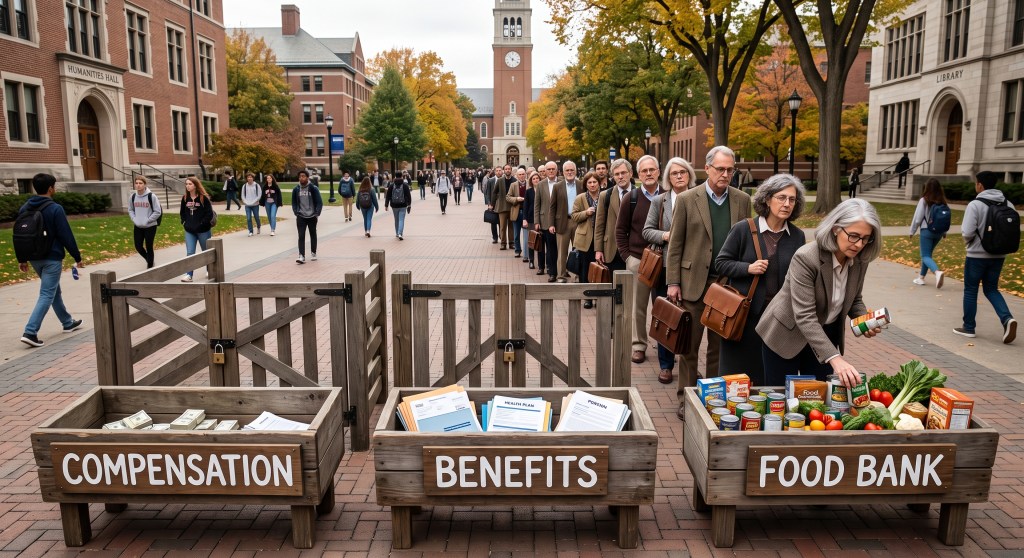
Picture the Tuesday afternoon routine of a college professor in 2026.
At 1:00 PM, you step into a tiered lecture hall to teach an advanced seminar on classical political economy or evolutionary biology. At 2:30 PM, you hold “office hours” at a crowded, sticky table in the student union Starbucks because your department doesn’t provide adjuncts with desks, let alone fully equipped offices and support staff.
At 4:15 PM, you pack your laptop, pull your jacket hood low, and walk around to the loading dock behind the campus recreation center.
You take your place in line at the university’s “Basic Needs Hub.” Standing three people ahead of you is a sophomore from your 1:00 PM lecture. You both carefully avoid eye contact while waiting for a work-study student to hand out cardboard boxes of generic pasta, canned black beans, and shelf-stable oat milk.
This is not a dystopian parody. It is the lived reality across hundreds of American college campuses today.
Over the past few years, a quiet, surreal policy shift has swept through institutional higher education: campus food pantries, originally established to help low-income undergraduates navigate soaring room-and-board fees, have quietly updated their intake rules. The signage on the door used to say “Serving All Enrolled Students.” Now, across regional state schools and private universities alike, the mission statements have been updated: “Open to Students, Staff, and Faculty.”
Recent labor surveys and basic-needs assessments confirm what every contingent instructor already knows in their bones: roughly a quarter of non-tenure-track academic instructors experience food insecurity, and thousands are forced to rely on federal assistance like SNAP or Medicaid just to feed their families while actively teaching credit-bearing university courses.
The university administration’s response to this crisis? They put a donation bin for canned tuna in the dean’s office lobby and send a campus-wide email praising the “spirit of community care.”
It is hard to imagine a more grotesque milestone in the collapse of the academic profession and the institutional employer-enroller legacy we have assumed without challenge.
The Walmart Playbook with Gothic Arches
When a multinational corporation like Walmart or Amazon pays its warehouse workers such abysmal wages that thousands of them qualify for food stamps, everyone rightly recognizes it for what it is: a predatory business model that externalizes the cost of human survival onto public assistance while privatizing billions in corporate profit.
Yet when the corporate university (Universitas) does the exact same thing, it wraps itself in the velvet cloak of nonprofit philanthropy and community care.
Consider the economic absurdity of the setup:
- The institution charges an eighteen-year-old student $30,000 to $65,000 a year in tuition and fees, bundling academic credit with real-estate debt.
- The board of trustees pays the university president a median base salary of $850,000 (with top executives pulling down over $2 million), while vice chancellors of “brand engagement” and associate deans of “belonging” routinely clear $200,000 to $400,000.
- Meanwhile, the instructor actually delivering the core educational product—the person grading the essays, designing the labs, and mentoring the students—is paid an average piece-rate of $3,500 to $4,093 per three-credit course, with zero health insurance, zero retirement contributions, and zero job security past the final exam.
If an adjunct instructor manages to secure three courses in a term—a workload of prep, grading, and emotional labor for 90 to 120 students—they gross about $11,000 for four months of work. After taxes, gas, and rent in an inflated metropolitan housing market, there isn’t enough money left to buy groceries.
So the university steps in with its “solution”: institutional breadlines.
Instead of paying a living wage, the university builds a charity closet. The administration treats faculty starvation not as a structural crime of exploitation that they are actively committing, but as an unfortunate act of God—like a sudden rainstorm—that can be mitigated by encouraging colleagues to donate jars of peanut butter during the campus holiday food drive.
It is institutional gaslighting at its most cynical. The landlord steals 85 percent of the value of your labor, leaves you in the dirt, and then asks for applause when they toss you a bag of lentils.
The Total Enclosure of Precarity
Why does this indignity persist? Why do scholars with terminal doctorates, publications, and years of pedagogical experience allow themselves to be herded into campus food pantries?
Because the employer-enroller monopoly has systematically enclosed the profession.
Inside the corporate university framework, the scholar exists as a subordinate employee (locatio operarum). The legal authority to grant a degree, validate a transcript, and collect tuition is monopolized entirely by the state-chartered, accredited institution.
If you want to gainfully earn from your intellectual calling, you have no choice but to sell your labor to an institutional landlord. And because the corporate university has spent forty years shifting its instructional workforce to a 68 percent contingent majority, the academic job market operates as a desperate buyer’s market.
Administrators know that for every adjunct who burns out, quits, or complains about having to skip meals, there are three desperate, newly minted Ph.D. graduates coming off the assembly line, eager to take the same $3,500 stipend just to keep their CV and hope of tenured employment alive.
The result is a system of psychological and material subjugation:
- Professional Humiliation: The scholar is stripped of all professional dignity. How can you command intellectual authority in a classroom when you have to calculate whether you can afford to buy lunch after class? How do you mentor students into the middle class when you are one unexpected medical bill away from eviction?
- Invisible Labor: Because contingent instructors are treated as temporary seasonal workers, their desperation is compartmentalized. The institution hides them from donors, hides them from prospective parents, and hides them from the public viewbooks.
- The Charity Trap: By reframing systemic wage starvation as a “basic needs” issue, the administration depoliticizes the crisis. It turns a question of exploitation into a question of volunteerism and wellness apps.
Why the Traditional Trenches Keep Failing
The response from academic labor unions and faculty senates has been predictable and remains trapped inside a losing paradigm.
For decades, organizing efforts have focused on collective bargaining within the institution: staging rallies, filing unfair labor practice charges, and demanding higher per-course stipends.
Yet even when a union wins a hard-fought contract after months of picket lines, what does the victory look like? An increase from $3,800 to $4,300 per course over a four-year phase-in. Meanwhile, runaway inflation eats the raise before the first paycheck clears, and the administration quietly claws back the cost by increasing class caps from 30 to 45 or cancelling low-enrolled sections two days before the semester starts.
You cannot reform an employer whose entire balance sheet is predicated on your precarity.
The corporate university did not accidentally let faculty fall into poverty; contingent labor is the financial engine that pays for the university’s bond debt, executive salaries, and capital expansions and repairs. If the university paid every instructor a dignified, proportional share of the tuition they generate, the corporate campus would go bankrupt tomorrow.
Pleading with the landlord for a higher piece-rate inside the company town is a dead end. We need to leave the town and resume the cottage industry.
The PSA Antidote: The Great Decoupling
The spectacle of a professor lining up at a campus food pantry should be the final, definitive proof that the institutional university model is dead. It is time for The Great Decoupling.
The Professional Society of Academics (PSA) was designed to eliminate the extractive landlord that stands between educators and students.
Here is what happens to the food-pantry professoriate when we abolish the institutional middleman:
1. Direct Contracts Replace the $3,500 Piece-Rate
In the corporate university, a classroom of thirty students pays an aggregate tuition of $60,000 to $90,000 for a course. The institution keeps $86,000 to subsidize its real-estate empire and hands the adjunct professor a check for $4,000.
Under the PSA, that entire predatory rake is dismantled.
Through the Direct Contract, the licensed academic enters a direct educational agreement with a cohort of learners. Operating under the principle of Parsimonious Practice, all the non-instructional corporate overhead—the $850,000 presidents, the marketing firms, the climbing walls, the bond debt—is eliminated.
- A sovereign practitioner leases an accessible seminar room in a local public library, high school, university, college, civic center, or downtown storefront.
- The scholar convenes a small, intensive seminar of 12 students, charging an accessible, humane fee of $1,000 per student for a semester-long credit course.
- That generates $12,000 in gross revenue for a single class—flowing 100 percent to the practitioner.
Teaching just two small cohorts a semester yields $24,000 per term—nearly triple what an adjunct makes running between three different campuses, for a fraction of the exhaustion. An academic teaching a normal full-time load of four small cohorts a year earns a dignified, secure professional income of $80,000 to $100,000, with full control over their labor.
2. Portable Licensure Destroys the Landlord’s Leverage
Why does an adjunct accept $3,500 today? Because they have nowhere else to go. The corporate university owns the degree-granting authority.
Under the PSA, accreditation is decoupled from the physical building.
- Academic authority is vested inalienably in the scholar through Portable Licensure, certified by an autonomous, horizontal Guild (Societas) of disciplinary peers.
- The authority to teach, assess rigor, and issue legitimate academic credit belongs to you, not to a dean, a board of regents, or a state-approved accreditation board.
- An administration cannot threaten to starve you by cutting your courses, because they do not control your license to practice higher education.
3. Sovereign Public Practice Restores Professional Dignity
Under the PSA, academics are no longer disposable gig-workers groveling for an adjunct line; they are independent higher education firms of one.
You don’t hold office hours in a noisy coffee shop because you have no desk. You establish a sovereign public practice within your local community. Your teaching rigor and scholarly output are documented openly on the Public Practice Record (PPR) ledger, evaluated by professional peers rather than administrative bean counters.
You do not stand in a food pantry line behind the students you just taught. You sit across from them as an autonomous, self-governing intellectual mentor who owns their own practice and answers only to the truth and the standards of the professional guild.
Put Down the Canned Beans. Pick Up Your Profession.
To every adjunct professor reading this who has ever felt the sting of shame standing in a campus food pantry line, or who has skipped meals in the final week of the month waiting for an adjunct check to clear:
The shame does not belong to you.
The shame belongs to an institutional apparatus that extracts billions from students while paying you piece-wages that leave you malnourished. The shame belongs to university presidents who preach social justice at graduation while running an instructional plantation.
You did not spend a decade mastering your discipline to become an administrative charity case.
The expertise is yours. The pedagogy is yours. The intellectual authority is yours. The university building is just a means, not ends.
Stop waiting for the landlord to put more tuna fish in the donation bin. It is time to execute a Great Decoupling, claim your Portable Licensure, and build the Professional Society of Academics.


Leave a comment