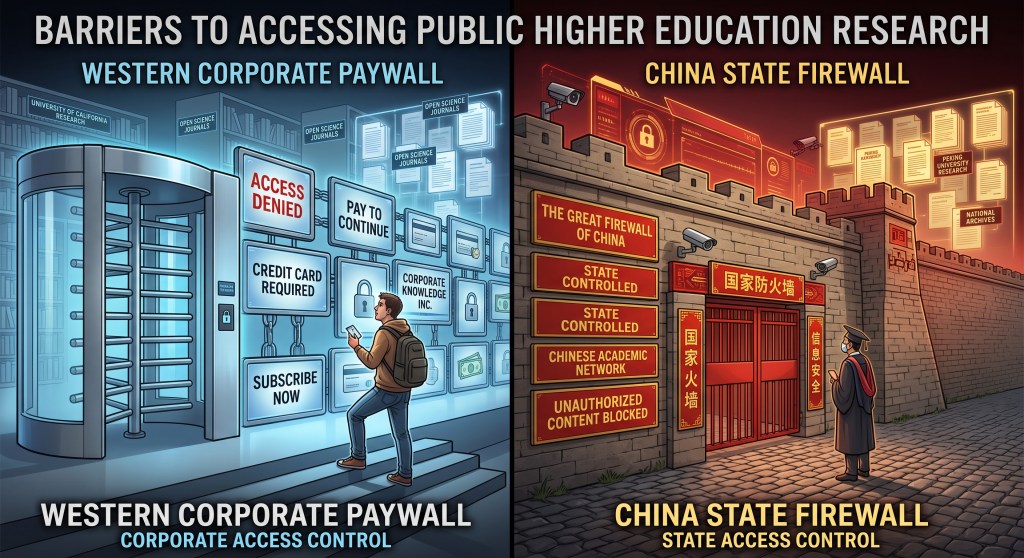
If you want to understand the absurd comedy of modern research publishing, you have to appreciate the great academic grift.
Consider how the racket works in the “free, democratic” West. A scholar spends three years conducting research funded by public tax dollars. They write up the findings. They submit the manuscript to a prestigious journal owned by a private publishing conglomerate like Elsevier, Springer Nature, or Wiley.
Does the publisher pay the scholar for this labor? Of course not.
Does the publisher pay the peer reviewers who spend their weekends stress-testing the methodology and vetting the citations? Not a red cent.
Instead, the publisher takes the finished, peer-reviewed paper, slaps a digital copyright stamp on the PDF, and hides it behind a paywall. Then, the publisher turns around and sells institutional subscriptions back to the very university library where the work was done—charging millions of dollars a year for bundled access packages. If an independent researcher, an inquisitive student, or a taxpaying citizen tries to read that publicly funded paper from home, they are met with a digital bouncer: “Rent this article for 24 hours: $41.95.”
It is a business model so cartoonishly extractive that it routinely posts operating profit margins north of 35 to 40 percent—higher than Apple, Google, or Big Oil.
Now look across the Pacific at the People’s Republic of China.
In Beijing, they don’t rely on Amsterdam-based corporate publishers to milk their researchers. They built their own homegrown, state-backed academic monopoly: the China National Knowledge Infrastructure (CNKI). CNKI ingested over 95 percent of China’s published academic literature, consolidated digital dissertations, and became the sole gatekeeper of the nation’s intellectual production. And then, predictably, CNKI began acting like a predatory monopolist under the whip of the Chinese Communist Party (CCP). It raised university subscription fees by double-digit percentages year after year, until even the prestigious Chinese Academy of Sciences publicly revolted, announcing it could no longer afford the multi-million-yuan toll.
That revolt forced the Chinese state’s antitrust watchdog, the State Administration for Market Regulation (SAMR), to swoop in, slap CNKI with antitrust fines, and order it to lower its fees and stop anti-competitive exclusive copyright licensing.
Western academics laughed at the irony: Look at authoritarian China having to trust-bust its own state-sponsored academic database while pushing its “Double First-Class” university rankings drive!
Except the Western academic forgot to look in the mirror.
Beijing’s bureaucrats and Western corporate publishers are running the exact same play: enclosing the human knowledge commons inside an institutional paywall and selling it back to the public as a proprietary commodity.
The Two Faces of the Knowledge Cartel
Whether you are navigating the Great Firewall in Beijing or the corporate paywalls of Manhattan and London, the structural outcome for scholars and students is identical: human inquiry is locked in a vault, metered for profit, and hoarded for institutional prestige.
| Dimension | The Chinese State-Capitalist Cartel (CNKI) | The Western Corporate Cartel (Elsevier / Springer) |
| Primary Gatekeeper | State-backed digital monopoly (CNKI) monitored by CCP overseers | Commercial publishing oligopoly backed by multinational IP cartels |
| Funding Source | Direct state funding and ministerial university grants, and student tuition extraction | Public taxpayer grants (NIH, NSF, UKRI) and student tuition extraction |
| Labor Compensation | Academics write, review, and edit for zero direct pay | Academics write, review, and edit for zero direct pay |
| Extraction Mechanism | Monopoly pricing imposed on public research institutes and universities | Subscription bundle extortion ($2M–$5M/yr per campus) and predatory paywalls |
| The “Reform” Trap | State nominal antitrust fines that preserve state control of the database | “Gold Open Access” author processing charges ($3,000–$10,000 per paper) |
| Underlying Ideology | State-directed knowledge nationalism and techno-authoritarian security | Corporate asset financialization and institutional prestige games |
In both spheres, the inherited, unchallenged institutional model for higher education has allowed the fruits of human curiosity to be captured by predatory middlemen, including university and college publishing houses.
In China, the state uses data enclosure to control the narrative and monitor intellectual deviation. If a paper challenges state ideology or exposes inconvenient economic data, CNKI simply de-indexes it or restricts access.
In the West, the corporate university uses commercial journal prestige to maintain its exclusionary rankings racket. A scholar’s promotion, tenure, and livelihood depend on publishing in high-impact-factor proprietary journals owned by corporate conglomerates.
And when the public pushed back against the Western paywall scam, what did the publishers do? Did they dismantle the tollbooths?
No. They invented the Article Processing Charge (APC), otherwise known as “Gold Open Access.”
Now, the publisher magnanimously agrees to make your article free for the public to read—provided the author’s university or grant lab pays the publisher $3,000, $5,000, or even $11,000 upfront just to click “Publish.”
They flipped the tollbooth from the reader to the writer. If you work at an elite, well-funded R1 institution with a massive indirect-cost slush fund, you can afford to buy public visibility. If you are an adjunct instructor, an early-career researcher, a community college teacher, or a scholar in the Global South, you are locked out of the discourse. The paywall to read has simply become a paywall to participate.
Why the Legacy System Cannot Liberate Academic Research
The establishment’s proposed fixes to these data monopolies are laughable exercises in bureaucratic tinkering.
In China, the state thinks the solution is state regulatory discipline: fining CNKI, forcing structural price cuts, and mandating that domestic research be indexed in state-approved national repositories. But that just tightens the Communist Party’s grip on the database. It trades a commercial monopoly for a direct ideological panopticon.
In the West, university library consortia try “transformative agreements” and collective bargaining boycotts. A university system like the University of California theatrically cancels its Elsevier contract for eighteen months, issues brave press releases about open access, and then quietly signs a new multi-million-dollar compromise deal that bundles APC vouchers with digital subscriptions.
Why do these boycotts always collapse?
Because the corporate university (Universitas) is structurally addicted to the journal cartel’s prestige.
A corporate university doesn’t evaluate its faculty’s scholarship by actually reading it; it evaluates scholars using administrative proxy metrics manufactured by the publishers themselves—Impact Factors, H-indices, and Scopus citation scores. The university needs the publisher’s brand name (Nature, Econometrica, Noûs) to justify charging students $60,000 a year, and the publisher needs the university’s free faculty labor to generate the content and profit margins.
They are codependent partners in an abusive marriage. You cannot fix the knowledge monopoly by begging the publisher for lower subscription rates or pleading with the state to audit the digital database.
The entire framework of predatory, proprietary, institutionally enclosed scholarship must be scrapped.
The PSA Remedy: Authentic “Knowledge Socialism”
The Professional Society of Academics (PSA) does not advocate for “open access” within the entrenched publishing racket. It advocates for a Great Decoupling of research, peer review, and credentialing from both commercial publishers and state-controlled databases.
The call is for authentic knowledge socialism—the radical reconstitution of scientific and intellectual production as an unowned, unmonopolized, borderless public commons.
Here is how the PSA replaces the knowledge cartels:
1. The Public Practice Record as an Immutable Global Commons
In the PSA, research is never signed over to a commercial publisher, hidden behind a paywall, or sequestered inside a state-policed intranet.
Every licensed academic practitioner’s scholarship, methodology, dataset, and teaching record is inscribed directly onto the Public Practice Record (PPR) ledger.
- The PPR is a decentralized, open-access, public ledger governed directly by the horizontal PSA Guild (Societas), not a private equity board or a government ministry.
- Research papers are published openly to the global commons the moment they are completed, freely accessible to every human being on earth with an internet connection—no subscriptions, no $40 paywalls, and zero author fees.
2. Open, Post-Publication Peer Review
How is quality and rigor maintained without corporate journal gatekeepers?
Through transparent, continuous peer evaluation conducted on the public ledger.
- In the PSA, peer review is a recognized act of academic practice, that stands as a condition of the professional licensure to practice higher education.
- Certified practitioners across the disciplinary colleges review, replicate, and critique research openly on the PPR.
- A paper’s intellectual authority is not determined by the glossy logo on the cover of a magazine; it is determined by the transparent, documented consensus of sovereign peers who attach their professional reputations to their reviews.
Fraudulent data, manipulated p-values, and cut-and-paste citations cannot hide behind the veil of proprietary journal confidentiality. The research is audited in the open, in continuous real time, by the global community of practitioners.
3. Sovereign Practice Eliminates the Publisher’s Leverage
Why do academics currently surrender their intellectual property to cartels like Elsevier or CNKI? Because their institutional employer requires it for tenured and other types of employment status.
Under the PSA, scholars operate in Sovereign Public Practice as independent professional firms of one, holding an inalienable Portable License. No monopolistic HR departments are needed or recommended.
- There are no tenure-review committees demanding three Nature papers to keep your job.
- There are no university provosts counting citation metrics to decide your salary or renewal of your employment contract.
- An academic’s standing is anchored permanently in their documented contributions to the discipline and their students, verified on the open PPR.
When scholars own their practice and answer directly to their peers, the commercial publisher loses 100 percent of its leverage. If Elsevier or Springer wants our research, they can read it on the public ledger like everyone else. They will never own it again.
Science Belongs to the Species, Not the Cartel
Knowledge is not a barrel of crude oil to be metered by an OPEC of European publishers. It is not a state secret to be walled inside a provincial database by party apparatchiks in Beijing.
The Pythagorean theorem, the laws of thermodynamics, the critique of political economy, and the structure of the genome belong inalienably to the human species.
It is time to stop playing the sequestered knowledge game.
Let the Chinese state regulators fine their domestic monopolies. Let Western universities bankrupt their libraries buying back the research their own faculty gave away for free.
The Professional Society of Academics provides the architecture to walk away from both the firewall and the paywall. Through the Public Practice Record and Sovereign Public Practice, we can build a genuine, transnational knowledge republic—where inquiry is free, research is open, and no scholar or student ever has to slide a credit card to pursue self and societal advancement.
Break the cartels. Build the Guild. Build a genuine knowledge commons.


Leave a comment