If you want to understand why higher education is in a state of advanced moral rot, you don’t need to look at falling test scores or corporate administrative salaries. You just have to look at what happens when a violent felony occurs inside the gated perimeter of an Ivy League institution.
This week, the spotlight is on Ithaca, New York. An explosive civil lawsuit filed against Cornell University, the national Chi Phi fraternity, and seven former students details an alleged hours-long, ketamine-fueled gang rape of an incapacitated female student inside a fraternity house. According to the complaint, while the assault was underway, a message was sent to a chapter Snapchat group chat titled “Chi Phi Actives” announcing “free pussy upstairs,” prompting more members to participate.
The alleged crime is monstrous. But the university’s subsequent handling of it is pure, unadulterated corporate higher education.
According to the victim’s attorney, after the assault was reported to the Cornell University Police Department (CUPD)—a common expense of campuses that nationally costs $2.7 billion—the case disappeared into an internal administrative labyrinth. The university held twelve private hearings. Not a single person was arrested. Out of seven accused fraternity members, only two were expelled; the rest received suspensions or were reportedly permitted to submit “reflective essays” to mitigate their sanctions. The local county district attorney declined to bring criminal charges at the time, openly admitting his office didn’t independently investigate and instead relied entirely on Cornell’s campus police. It took a high-profile civil lawsuit, nationwide outrage, and celebrities shaming the institution on social media for the local prosecutor to finally reopen the criminal probe and send the case to a grand jury.
Cornell’s response? The standard crisis-communications checklist: release a defensive statement citing federal privacy laws (FERPA), assure the public that “consequential punishments” were handed down, highlight that the specific fraternity chapter was banned, and point to an administrative “task force on sexual assault.”
We have seen this movie before. We saw it at Virginia. We saw it at Dartmouth, Stanford, Baylor, and Penn State. For generations, American residential campuses have served as petri dishes for illegal and predatory behavior—gang rapes, hazing deaths, lethal alcohol poisonings, drug syndicates, bribery, extortion, and hush-money settlements.
The cultural commentariat always treats these disasters as isolated failures of “campus culture” or “fraternity regulation.”
They are lying to themselves and us. What happened at Cornell is not an aberration. It is the inevitable outcome of the employer-enroller monopoly on the social good of higher education.
The Feudal Company Town and Its Private Bouncers
To understand why elite colleges handle violent crime like an HR complaint, you have to understand what a residential university (Universitas) actually is.
It is not an educational collective. It is a quasi-sovereign company town.
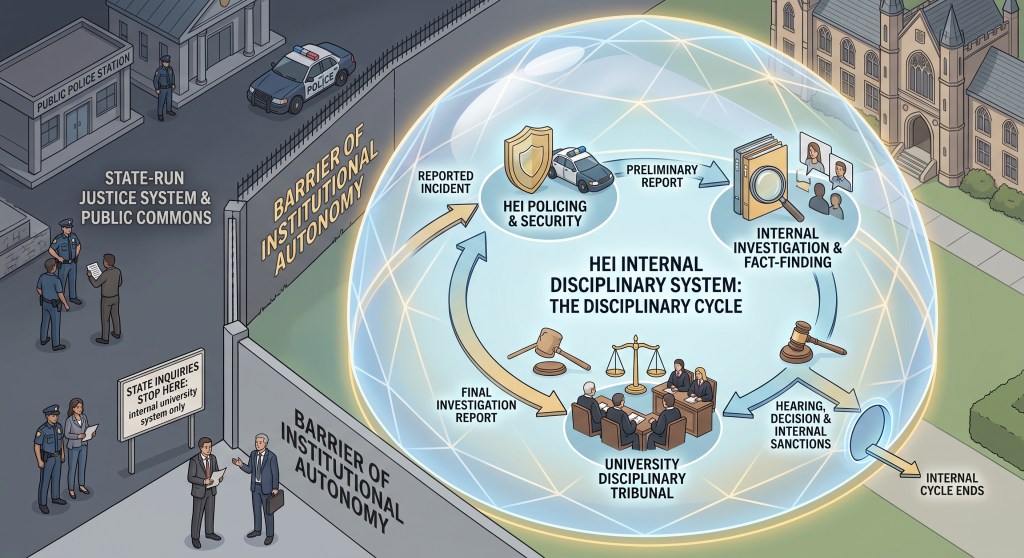
Unlike an adult vocational school, an art institute, or a professional guild, the American residential university insists on operating as a total institution. It owns the land, the dormitories, the dining halls, the athletic arenas, and the social clubs. And to protect this multi-billion-dollar real-estate empire, the state grants the university something extraordinary: its own armed, private police force and an internal, extra-judicial legal system.
Consider the grotesque conflict of interest at the heart of campus policing:
- When a student reports a violent felony to a municipal police department, the police department’s legal mandate is to investigate a crime under the penal code.
- When a student reports a violent felony to a campus police department, the officers work for an administration whose overarching fiduciary duty is to protect the university’s brand equity, bond rating, and donor pipeline.
The institutional imperative of the corporate university is not justice. It is liability mitigation and scandal containment for bottom-line preservation.
Every time a rape, a drug overdose, or a hazing death becomes public, the institution faces catastrophic PR damage, plummeting admissions yields, and multi-million-dollar civil lawsuits. The campus apparatus therefore has every financial incentive to divert criminal offenses away from public courtrooms—where subpoenas, public records, and grand jury testimony can expose institutional negligence—and route them into opaque, internal disciplinary panels.
That is how you end up with an Ivy League university adjudicating a gang rape behind closed doors, handing out suspensions, and asking perpetrators to write “mitigation essays.” In what other precinct of American civic life is an alleged sexual assault handled with a homework assignment? If seven men drugged and assaulted a woman inside a public hotel or a corporate home office, the municipal SWAT team would kick down the door, and the suspects would be booked in county jail within hours.
On the corporate campus, it gets referred to the Office of Student Conduct and an Associate Dean of Belonging.
The Bundling Racket: Greek Feudalism and the Vice Playground
Why are universities in the business of policing young adult bedrooms in the first place?
Because the corporate university’s financial model relies on the bundling of adult intellectual inquiry with an adolescent finishing school.
Centuries ago, the concept of in loco parentis (in place of the parent) meant that university masters supervised the moral development of teenage boys. In the late 20th century, the corporate university abandoned the moral supervision, but kept the residential real-estate monopoly—because that is where the profit margins live.
Today, higher education institutions do not sell higher education. They sell an enclosed lifestyle experience. They charge parents $60,000 to $90,000 a year to bundle five unrelated things:
- Academic instruction (delivered mostly by exploited adjuncts and graduate students),
- A luxury real-estate lease (dorms and dining halls),
- An unmonitored social playground (Greek life and party culture),
- An exclusive credentialing monopoly, and
- A full-authority policing force.
Greek life—the fraternity and sorority system—is the engine of this playground. Elite universities tolerate and protect fraternities not because they foster scholarly excellence, but because they are massive fundraising pipelines. Fraternity alumni become the hedge-fund managers, corporate lawyers, and real-estate developers who donate tens of millions to university capital campaigns. The fraternity houses themselves often sit on valuable campus-adjacent land owned by wealthy alumni corporations.
So the university makes a cynical pact: it allows Greek fiefdoms to operate as unregulated, off-the-books alcohol and drug distribution hubs to lure affluent 18-year-olds to campus, while relying on institutional non-disclosure agreements, campus police, and Title IX liability shields to clean up the blood and trauma when the system inevitably explodes.
It is an insane way to organize a social good.
Why should a 20-year-old who wants to study mechanical engineering, comparative literature, or statistics be forced to live inside a feudal social hierarchy dominated by 19th-century drinking clubs?
Why is the pursuit of human knowledge welded to an environment designed to encourage binge drinking, chemical coercion, and tribal entitlement?
Why are citizens, who happen to be students, investigated by a non-state police system?
The Title IX Farce
Whenever a scandal like Cornell’s breaks, the standard liberal-technocratic response is to demand “Title IX reform.”
Advocates call for more Title IX compliance officers, longer mandatory online consent modules during freshman orientation, and stricter federal guidelines for campus tribunals.
It is an exercise in profound delusion.
Title IX was originally passed to ensure equal access to educational resources. Over the past twenty years, it has been mutated into a privatized, bureaucratic star chamber where corporate administrators attempt to perform the work of criminal courts without the constitutional tools of the judicial courts.
Title IX administrators cannot issue search warrants. They cannot compel witness testimony under penalty of perjury. They cannot subpoena phone records or forensics. They are university middle-managers trained in HR risk management, forced to play judge, jury, and prosecutor in allegations involving serious criminal violence among citizens.
The result is a system that satisfies no one and harms everyone:
- Victims are subjected to multi-day, traumatic inquisitions by university bureaucrats who are ultimately trying to assess whether the victim is likely to sue the university.
- The accused are denied basic constitutional due process, with evidentiary standards shifting depending on which political party occupies the White House.
- The public is kept in the dark by FERPA privacy firewalls that allow administrators to conceal the names of offenders and the details of institutional negligence.
You cannot fix a structural contradiction by hiring more Title IX investigators. The problem isn’t that the internal tribunal needs better training; the problem is that an educational employer-enroller has no business running a private justice system, any more than a Google or Microsoft campus does.
The PSA Antidote: The Great Decoupling
The tragedies of Cornell, Virginia, and every other campus that preceded them will continue on an unbroken loop until we dismantle the structural root of the crisis: the bundled residential campuses of our unchallenged higher education inheritance.
The Professional Society of Academics (PSA) does not propose reforming the campus police or drafting another university code of conduct. It proposes a Great Decoupling.
We must separate higher education from the real-estate compound, the fraternity compound, and the private corporate police force.
1. Unbundle the Adult from the Playground
Higher education is the intellectual pursuit of rigorous knowledge, scientific inquiry, professional certification, and personal development. It is an adult endeavor.
Under the PSA, students are treated as sovereign civic adults, not infantilized wards of an institutional landlord.
- There are no campus dormitories, no student centers with climbing walls, and no university-chartered fraternity houses.
- Scholars practice in the civic world—leasing seminar spaces in municipal libraries, leased storefronts, independent community knowledge hubs, or the taxpayer-built public campuses.
- Students live where adults live: in municipal neighborhoods, local housing, or with their families, fully embedded in normal civil society.
When an 18-to-22-year-old lives as an adult citizen in an ordinary city, the toxic greenhouse of the enclosed campus evaporates. If a crime occurs, it does not get reported to a university-employed police chief who reports to an executive vice president. It gets reported to the municipal police, investigated by detectives under the penal code, and prosecuted in a public court of law where crimes belong.
2. The Direct Contract Replaces the Feudal Bundle
In the corporate university, parents pay an exorbitant, bundled fee that forces them to subsidize fraternity mansions, campus police liability insurance, and multi-million-dollar PR crisis teams.
Under the PSA principle of Parsimonious Practice, all of this non-instructional fat is abolished.
- Through the Direct Contract, a student pays an accessible, human-scale fee (e.g., $1,000 per course) directly to a licensed, sovereign academic.
- The scholar focuses 100 percent of their labor on intellectual rigor, pedagogy, assessment, and mentorship.
- The scholar is not an RA, a chaperone, a mandatory reporter, or an amateur detective. Their professional duty is clear: intellectual instruction and ethical evaluation of student mastery inscribed on the Public Practice Record (PPR) of the PSA.
3. Abolishing the Corporate Shield
Why did the Cornell perpetrators allegedly receive essay assignments instead of handcuffs? Because Cornell University’s corporate body stood between the alleged crime and the justice system.
When you decouple education from the institution, the corporate shield disappears. There is no university administration to negotiate behind closed doors with the local district attorney, who is cognizant of the political and pecuniary pull of a Cornell, Harvard, or University of California. There is no board of trustees pressuring the local press to soften coverage to protect a capital campaign.
The academic profession ceases to be an accomplice to criminal cover-ups because the profession is no longer owned by the crime scene.
Demolish the Company Town
The horrific lawsuit emerging from Cornell is not an indictment of higher learning. It is an indictment of the custodial real-estate cartel that has hijacked higher learning for profit.
For a century, parents have been sold the myth that sending their teenage children to an enclosed, leafy campus compound is the safest, most prestigious path to productive adulthood. The mounting graveyard of hazing victims, sexual assault survivors, and institutional cover-ups proves that the exact opposite is true. The residential corporate campus is an engine of systemic unaccountability.
It is time to stop pretending that an online orientation video or a new vice-provost task force will make the company town safe.
We don’t need safer fraternities. We don’t need better Title IX tribunals. We need to abolish the campus enclosure entirely.
Let the real-estate corporations collapse. Let the fraternities buy their own private insurance in the open market. And let scholars and students build an authentic, adult profession—where higher learning happens in the light of the public square, and where violent crime meets the full, unmediated force of public justice.
It is time to leave the compound. It is time to build a Professional Society of Academics.


Leave a comment