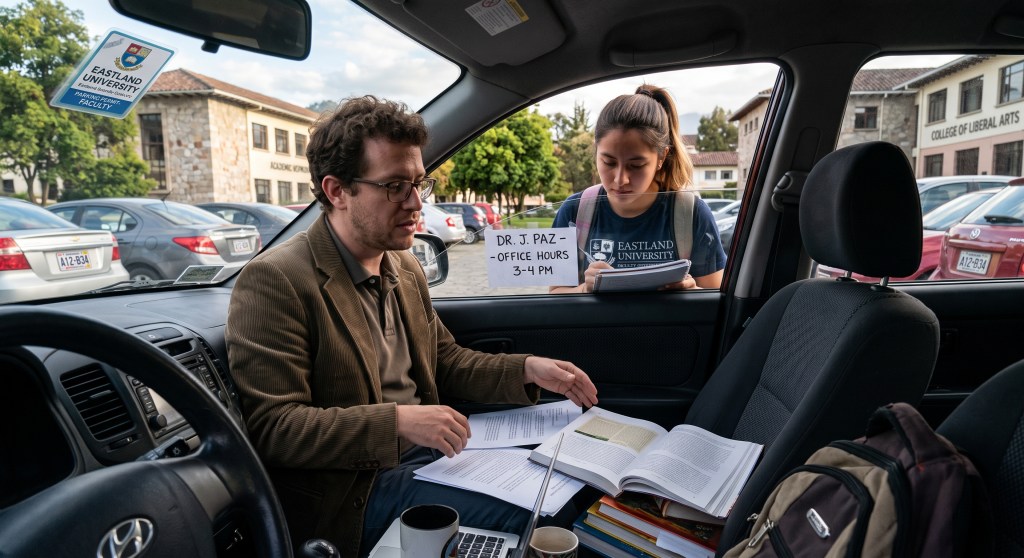
If you want to understand the material reality of contemporary academic labor, skip the glossy recruitment brochures featuring tweed jackets and ivy-covered stone arches. Walk out to the far edge of the commuter parking lot at your local community college around 9:45 PM on a Tuesday.
Look for the 2011 Honda Civic with peeling clear coat, parked under the hum of a flickering sodium-vapor light.
Inside, illuminated by the cold blue glow of a laptop screen and a clip-on reading lamp clamped to the sun visor, sits a Ph.D. in comparative literature or theoretical mathematics. The passenger seat is piled high with manila folders, bluebooks, and half-eaten protein bars. The glove compartment houses emergency dry-erase markers and extra printer paper. The back seat is an archival filing cabinet containing four different course syllabi for three different college districts.
This isn’t an eccentric lifestyle choice. This is the Freeway Flier—the engine that keeps higher education running.
Across high-traffic metropolitan corridors from Southern California and the Bay Area to the Interstate 95 sprawl linking New York, New Jersey, and Philadelphia, tens of thousands of professors spend their working lives trapped in a grueling game of regional musical chairs. They cobble together five, six, or seven courses a semester across three or four separate institutions just to scrape together a gross income of $30,000 to $35,000 a year.
To survive, they spend three to four hours a day fighting highway gridlock, burning 20 to 25 percent of their net pay on gas, turnpike tolls, and brake pads. In hyper-expensive metro zones, instructors routinely sleep in their vehicles in the campus parking structure between an 8:00 PM evening seminar and a 7:30 AM introductory lecture the next morning because driving two hours home to an overpriced shared rental is impractical.
Welcome to the modern university: an institution that charges $40,000 to $60,000 a year for credentials while using the interior of a compact sedan as a mobile department wing.
The Corporate Racket of Total Cost Externalization
The academic establishment likes to frame the adjunct crisis as an unfortunate, accidental budget squeeze—a tragic consequence of legislative austerity that campus administrators are desperately trying to solve.
That is pure public relations fiction.
The proliferation of the freeway flier is not a failure of the corporate university (Universitas). It is one of its greatest financial triumphs. It is the calculated, systematic externalization of operating costs onto a disposable, hyper-exploited labor force.
Consider how Silicon Valley platform monopolies operate. A company like Uber or DoorDash doesn’t buy a fleet of cars, pay for vehicle maintenance, or purchase commercial insurance. They build a digital dispatch platform, extract a 30 percent toll on every transaction, and force the driver to shoulder 100 percent of the capital depreciation, gas, and health risks.
The Higher Education Institution (HEI) runs the exact same play, only with better revenue capture and branding:
- No Office Space: The institution doesn’t have to heat, cool, or clean an office for the instructor. By denying contingent faculty dedicated workspace, the university saves millions in square footage that can be converted into revenue-generating administrative suites or donor lounges.
- No Equipment Costs: The college doesn’t provide a computer, a phone, or home internet. In many departments, adjuncts aren’t even given a departmental printer code; they are forced to print handouts at FedEx Office or bring their own paper to the communal copier.
- No Healthcare or Retirement Overhead: By artificially capping an instructor’s course load at two classes per campus—just below the statutory threshold for Affordable Care Act benefits—the institution evades employer healthcare contributions entirely, forcing the instructor to buy catastrophic coverage on the public exchange or rely on Medicaid.
- No Office Hours Compensation: The university mandates “office hours” in the course catalog to satisfy accreditation boards, but refuses to provide a room to hold them in. The instructor holds conferences in noisy campus cafeterias, on concrete benches outside the library, or in the front seat of their car.
[See these financial analyses for the PSA model: United States, Canada, Australia.]
The university collects full tuition from the student, pays the lecturer a flat, insulting piece-rate of $3,500 to $4,000 per course, and externalizes the costs of facilities, equipment, transportation, and basic biological survival onto the scholar’s personal credit card.
Why the Reformist Trenches Lead Nowhere
Faced with this indignity, the traditional academic labor movement tells the freeway flier to organize: form an adjunct union, run for a seat on the academic senate, and demand a contract.
Collective bargaining has won important marginal battles, but it runs into an unyielding structural wall: the employer-enroller monopoly.
Inside the corporate university hierarchy, faculty are subordinate employees (locatio operarum). The institution owns the property, the degree-granting charter, the course catalog, and the student registration pipeline. As long as the institution controls the credentialing tollbooth, adjunct union negotiations inevitably degenerate into rearguard bargaining over crumbs:
- Fighting for three years to win a $150 increase in per-course pay, which is immediately wiped out by inflation and rising parking permit fees.
- Negotiating access to a “shared adjunct space”—a windowless basement room where forty instructors share three outdated desktop computers and four folding chairs.
- Pleading for “seniority rights” that can be dissolved overnight whenever a department decides to cancel a low-enrolled section forty-eight hours before the term begins.
You cannot unionize your way out of a business model that treats your basic working space as a disposable externality. Pleading with the board of trustees to give you a desk in the building merely validates the premise that you have no right to practice your intellectual calling unless the landlord rents you a chair.
The Exit Route: The Great Decoupling
The freeway flier doesn’t need a slightly better parking spot in the campus garage. The freeway flier needs an exit ramp.
The entire reason an academic is forced to spend twenty hours a week burning fuel between four college campuses is that accreditation is permanently anchored to the physical institution. If you want to earn a living teaching college students, the state decrees that you must sell your labor to an accredited campus landlord.
The Professional Society of Academics (PSA) smashes this structural extortion through The Great Decoupling.
What happens to the freeway flier when we separate the academic profession (Societas) from the corporate real-estate firm (Universitas)?
1. Portable Licensure Ends the Commuting Circuit
Under the PSA framework, the authority to teach, design rigorous curricula, and validate academic credit does not belong to a college district or a board of regents. It belongs to the scholar through Portable Licensure, certified by an autonomous, horizontal Guild of disciplinary peers.
- A scholar no longer needs an adjunct appointment from three different deans to teach history, mathematics, or sociology.
- Your credentials, your right to evaluate student mastery, and your professional legitimacy belong to you inalienably, traveling wherever you set foot.
2. Parsimonious Practice Replaces the Highway Grind
Why drive eighty miles across three counties to teach 150 students for a combined $28,000 a year?
Under the PSA principle of Parsimonious Practice, an academic establishes a sovereign public practice directly within the community of their choosing:
- Instead of burning gas commuting to three different suburban campuses, the scholar leases a quiet, dignified seminar space on a local public campus, in a downtown storefront, a municipal library, or an independent civic knowledge hub within five miles of their home.
- By entering into Direct Contracts with students and eliminating the 80 percent administrative rake that corporate universities skim off the top, the economics of teaching completely invert.
- If a scholar convenes two small, intensive cohorts of fifteen students and charges an accessible, humane fee of $1,000 per student for a semester-long seminar, that yields $30,000 in gross revenue for just two classes—matching an entire year of multi-campus adjunct exhaustion for less than half the instructional load.
No highway gridlock. No grading under a steering wheel. No dean auditing your syllabus. Just direct, face-to-face higher education delivered at human scale in a professional service and stewardship model.
3. The Public Practice Record (PPR) Replaces Institutional Patronage
Freeway fliers are trapped because their teaching labor is invisible. They receive superficial student satisfaction surveys that deans weaponize to deny rehiring, while their actual pedagogical rigor disappears into departmental archives.
The PSA’s Public Practice Record (PPR) ledger provides an open, immutable record of the scholar’s professional competence.
- Every course taught, every syllabus developed, and every cohort outcome is inscribed on the public ledger.
- Course rigor is certified through transparent Course Difficulty Scores (CDS) and blind peer evaluations conducted across the Guild.
- A scholar’s reputation and client base are built on transparent, documented excellence, freeing them from the arbitrary whims of adjunct coordinators and department schedulers.
Turn Off the Engine
To the adjunct professor sitting in that idling Honda Civic tonight, checking your gas gauge, grading papers by the dashboard lights, and wondering if this is what seven years of graduate school were for:
The system is not going to change its mind about you. The corporate campus did not overlook your need for an office or a living wage; it built its balance sheet on your willingness to supply your own car, your own health insurance, and your own desperation.
You do not need their permission slip to be a scholar. You do not need their campus parking pass to teach. The expertise, the passion, and the pedagogical mastery are not inside the administrative building. They are inside you.
Turn off the engine. Stop financing their business model with your gasoline and your spine.
It is time to execute The Great Decoupling, claim your Portable Licensure, and build a sovereign public practice of your own.


Leave a comment