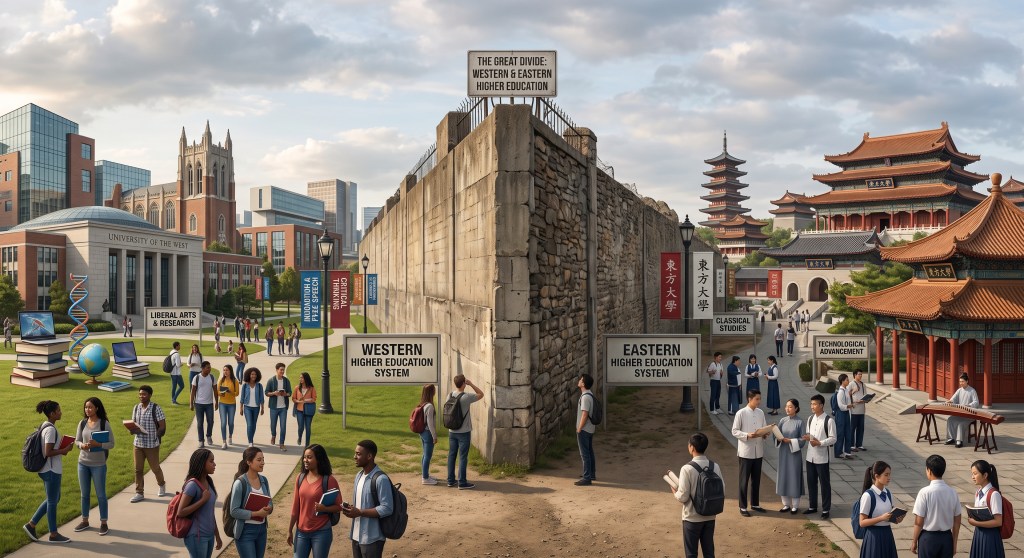
For decades, Western academics have enjoyed a comfortable sense of moral and intellectual superiority when looking across the Pacific.
Whenever the conversation turns to higher education in the People’s Republic of China, Western scholars shake their heads with sympathetic pity. Everyone knows the setup: at every Chinese university, from Peking University down to the provincial polytechnic, the university president is not actually in charge. Sitting right next to them—or more accurately, hovering directly over them—is the university’s internal Chinese Communist Party (CCP) Secretary. The Party Secretary heads the campus Party Committee, vets faculty appointments, monitors research agendas for ideological deviations from Xi Jinping Thought, and ensures the entire institutional apparatus serves the state.
To the Western academic sensibility, raised on romantic legends of the 1915 AAUP Declaration of Principles and the sacred covenant of “shared governance,” this arrangement looks like the ultimate totalitarian nightmare. Imagine, the Western professor chuckles over a macchiato in the faculty lounge, working in a system where political apparatchiks police your syllabi, monitor your classroom speech, and treat academic freedom as a counter-revolutionary threat.
Then the professor puts down their coffee, opens their laptop, and checks their morning email from the provost’s office in Texas, Florida, or Georgia.
And suddenly, the joke isn’t funny anymore.
Spot the Difference
If you are an academic trying to teach contemporary history, sociology, or public health in Austin, Tallahassee, or dozens of state capitals across the United States right now, your working conditions look uncomfortably familiar:
- In Texas and Florida, state legislatures have outlawed diversity, equity, and inclusion programs by statute, dispatched compliance auditors to scour course catalogs, and empowered politically appointed governing boards to fire tenured professors on expedited timelines.
- In the AAUP’s 2026 Faculty in the South Survey, more than 21 percent of respondents reported that campus administrators had personally questioned or censored their syllabi or curricular choices.
- At Auburn University, the administration dissolved the faculty senate outright—no faculty vote, no debate, just a stroke of the administrative pen.
- In Tennessee, the legislature passed HB 2194, stripping away statutory peer-review protections in faculty termination proceedings across the entire state system.
- At Cleveland State, the faculty senate was dismantled and replaced with an administrative puppet structure.
- Nationally, federal agencies spent the last two years freezing research grants, canceling millions in federal education contracts, and extorting elite private institutions into signing compliance compacts that place entire academic departments under federal receivership.
Now step back and compare the two offices.
In Beijing, the office down the hall belongs to a Party Secretary with a red flag on the desk and a copy of the latest Central Committee directives on the shelf.
In Austin, the office down the hall belongs to an executive chancellor—often a retired corporate lobbyist or failed politician pulling down a cool $850,000 base salary—whose shelves feature a golf trophy from a private club and a framed photo with the governor who appointed the board of regents.
One enforces ideological orthodoxy in the name of “Socialism with Chinese Characteristics.” The other enforces ideological orthodoxy in the name of “State Workforce Priorities” or “Donor Alignment.”
The aesthetics are different. The corporate branding is different. But operationally and legally, the machinery is identical: the state holds the deed and charter, commands the funding, authorizes credentialing, and dictates ways and means—right down to what the scholars enclosed by the campus or compound are permitted to think and speak.
The Myth of the “Free” Institutional Model
Western academics love to convince themselves that the political purges sweeping red-state campuses are an unprecedented, aberrant corruption of the university’s historic mission. They treat figures like Ron DeSantis or Greg Abbott as alien invaders who somehow hacked into the peaceful garden of higher education.
It is an absurd historical delusion.
The political and financial vulnerability of the university is not an anomaly; it is the foundational design flaw of the employer-enroller model (Universitas).
Whether in an authoritarian state-capitalist regime or a Western neoliberal democracy, the traditional university is organized around an asymmetric employer-employee hierarchy (locatio operarum). In this model, the academic does not possess sovereign professional authority. The academic is an employee who sells intellectual labor to a legal abstraction called the University of Tennessee or Western Virginia University.
And who owns that legal entity? The state legislature, the provincial government, or a self-perpetuating corporate board of trustees dominated by private equity magnates, corporate lawyers, and political donors.
The Chinese system simply does higher education the courtesy of honesty. The Chinese Communist Party does not bother with the polite fiction of “collegial shared governance.” It states plainly: The state founded this campus, the state funds this campus, the state owns the land, and therefore the state will determine the curriculum.
Western universities, by contrast, spent a century gaslighting their faculty with the illusion of “academic freedom.” They created faculty handbooks, advisory senates, and elaborate tenure review committees to convince professors that they were equal partners in a self-governing “knowledge commons.”
Except the moment a political majority decides to flex its muscles, the curtain gets ripped down. The board of regents rewrites the handbook. The president dissolves the senate. The state audit team examines the syllabi. And the professor suddenly realizes that their sacred “academic freedom” was never a constitutional property right—it was merely an uncollateralized coupon granted by a landlord who has decided to cancel the promotion.
The Architecture of the Hostage Compound
Why are universities in both China and the West so effortlessly captured by political power?
Because the corporate university is, by its very physical and financial nature, an enormous hostage compound.
Think about what it takes to run a contemporary institutional campus:
- Hundreds of millions of dollars in fixed real-estate assets and massive, gleaming concrete monuments.
- Astronomical commercial bond debts and capital maintenance backlogs exceeding $2 trillion nationally in the United States.
- An institutional addiction to centralized federal research grants and statutory Title IV tuition-aid spigots.
- A top-heavy managerial caste—presidents, provosts, vice-chancellors, and chief financial officers—whose primary obligation is protecting the institution’s bond rating and cash flow.
When an institution carries that much debt, relies on centralized state cash pipelines, and maintains an immovable real-estate footprint, it cannot resist political pressure. It is physically and financially impossible.
If Beijing threatens to withhold state research funding or demote a university’s standing in the “Double First-Class” rankings, the university administration immediately purges whoever the Party wants purged.
And what happened when Washington and state attorneys general threatened to freeze research overhead and revoke tax-exempt status from Columbia, Northwestern, or UCLA? The boards of trustees and executive suites folded instantly. They unleashed armed riot police on their own quads, locked their faculty out of decision-making, and agreed to federal monitoring of their hiring and curriculum.
You cannot defend intellectual liberty from inside a hostage compound. The moment the landlord is squeezed, the tenants are sacrificed to save the building, in a valuation of the institution over the individual.
The Triage Trap: Fighting for a Seat at the Master’s Table
Faced with this relentless state capture, what is the strategy of the Western academic establishment?
They run to the union hall and the faculty senate, dust off their 1940 AAUP statements, and plead for “shared governance” and “institutional accreditation protections”. They file desperate comments on federal dockets begging agencies to keep regional accreditors like SACSCOC in power, hoping an unelected institutional cartel will act as a buffer between their classrooms and the state legislature.
It is an exhausted, defensive triage.
As we have seen across the South, an advisory faculty senate has zero legal sovereignty. If the state legislature passes a law stripping due process (like Tennessee’s HB 2194), or if a board decides to dissolve a senate (like Auburn), an appeal to the 1966 Statement on Government of Colleges and Universities is about as effective as holding up a paper umbrella against a cruise missile.
Begging the board of trustees to respect “shared governance” is simply begging the master to be a little more polite. It accepts the master’s ownership of the ways and means as a fixed fact of nature, and merely negotiates over the quality of the rations and the tone of the administrative emails.
The Great Decoupling: Walking Out of the Compound
If the last decade of global higher education has taught us anything, it is this: You cannot protect the freedom of thought as long as the authority to practice is owned by an institutional employer-enroller.
The crisis in Beijing and the crisis in Austin share the exact same root cause: the enclosure of academic authority inside the corporate campus.
The only structural solution—the only permanent escape from the hostage compound—is a Great Decoupling and the establishment of something like The Professional Society of Academics (PSA).
The PSA does not attempt to reform the board of regents or replace the Party Secretary with a nicer administrator. It moves the entire foundation of higher learning out of the corporate firm (Universitas) and reconstitutes it as a horizontal, self-governing guild of sovereign practitioners (Societas).
1. Portable Licensure Destroys the Landlord’s Veto
Under the legacy model, academic legitimacy is tied to the building via institutional accreditation. If the institution fires you, your capacity to grant credit or practice your profession is extinguished.
Under the PSA, accreditation is abolished and replaced with Portable Licensure.
- The authority to teach, evaluate rigor, and validate academic credit is vested inalienably in the individual scholar, certified by an autonomous Guild of disciplinary and developmental peers.
- A governor, a board of regents, or a CCP committee has zero legal power over your license. They can ban you from their campus, but they cannot strip you of your professional legitimacy to practice credentialed higher education.
2. Sovereign Public Practice Replaces Subordinate Employment
In the PSA, scholars cease to be wage-laborers on a centralized corporate payroll. Every scholar operates as an independent professional firm of one, entering into Direct Contracts with students, other professionals, and civic communities.
When you practice as a sovereign academic:
- You do not ask an administrator for permission to assign a book, discuss critical race theory, or publish controversial climate data.
- You do not bend your curriculum to appease a corporate donor or a legislative committee.
- You answer strictly to your disciplinary peers, your professional code of ethics, and the transparent Public Practice Record (PPR) ledger.
3. Parsimonious Practice Eliminates the Extortion Target
Why can the state extort a university? Because the university requires hundreds of millions of dollars to service its real-estate debt, pay its $850,000 presidents, and keep its campus empire running.
Under the PSA principle of Parsimonious Practice, higher learning is stripped of all non-instructional corporate overhead.
- Sovereign academics practice in leased storefront seminar spaces, municipal libraries, and decentralized civic nodes.
- A scholar charging an accessible fee of $1,000 per student for an intensive, small-group seminar earns a dignified professional income while operating completely free of centralized state funding, corporate bond covenants, or administrative bloat. See these financial analyses for the United States, Canada, and Australia.
When there is no multi-million-dollar campus to protect, there is nothing for the state to seize. When there is no centralized payroll, there is no spigot for a politician or pandemic to turn off.
Stop Looking for a Nicer Landlord
Whether the man behind the executive desk is answering to a provincial Party congress in China or a partisan board of regents in the American South, the lesson is identical: he who owns the payroll owns the production of thought.
Western academics can spend the next twenty years retreating from state to state, filing toothless resolutions, and watching their faculty senates dissolved one by one. They can pretend that their blue-state campuses or elite private universities are immune, until the next federal funding freeze or compliance audit proves otherwise.
Or they can wake up to the structural reality of their subjugation.
The goal was never to win a friendlier boss in the executive suite. The goal was to eliminate the executive suite entirely.
It is time to stop confusing the university with higher education. Higher learning doesn’t belong to party secretaries, and it doesn’t belong to corporate regents. It belongs to the scholars and students who do the work. It is time to execute a great decoupling. It is time to leave the hostage compound behind and build a Professional Society of Academics.


Leave a comment