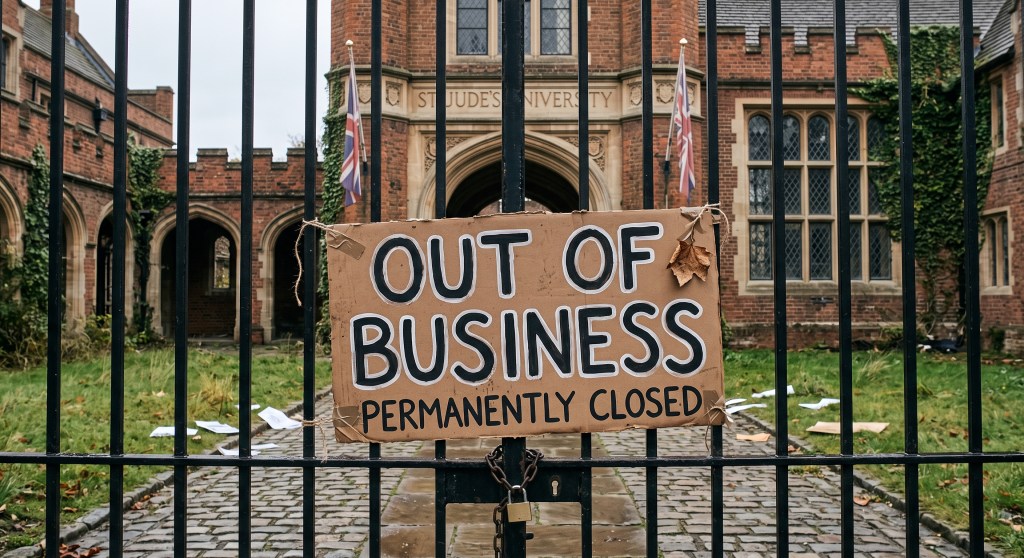
If you happen to take a stroll through the quad of almost any British university right now, you might notice an odd chill in the air. It’s not just the damp English weather. It’s the distinct smell of an entire national tertiary education sector quietly burning its own furniture to keep the central heating on.
According to sector-wide tallies, more than sixty universities across the United Kingdom—over half the country’s degree-granting institutions—have launched voluntary or compulsory redundancy schemes over the past year. From Kent and Goldsmiths to Aberdeen, Sheffield Hallam, and Queen Mary, the executioner’s block is out on the lawn.
Entire departments are being wiped off the map. Modern languages? Gone. Comparative literature? Luxuries we can no longer afford. Philosophy, art history, and pure mathematics? Pack your cardboard boxes, colleagues; the corporate spreadsheet says your discipline isn’t commercially viable.
Vice-chancellors are appearing on the BBC and writing hand-wringing op-eds in The Guardian, warning of imminent “catastrophic insolvencies.” They are pleading with the Chancellor of the Exchequer for emergency state bailouts, raising tuition caps, and warning that the “jewel in the crown of British soft power” is about to go bankrupt.
It is a spectacle of epic proportions. But before anyone sheds a tear for beleaguered British higher education, we need to ask the obvious question:
How did a sector that charges domestic students £9,250 a year, commands billions in government research funding, and sits on centuries of accumulated land wealth manage to drive itself to the edge of bankruptcy?
The answer is as simple as it is irresponsible: British universities spent two decades transforming themselves into predatory international visa-brokerage cartels, whose supply chains have broken.
The Business Model: A Luxury Hedge Fund with a Gothic Facade
To understand how UK higher education ended up in this financial crisis, you have to follow the money.
Back in 2012, the British government tripled domestic undergraduate tuition fees to £9,000, promising that the magic of the free market would create a consumer-driven educational utopia. But then a funny thing happened: the government froze that tuition cap for nearly a decade. In real terms, eaten away by runaway inflation, that domestic £9,250 fee is now worth closer to £6,000.
Did the universities respond to this fixed revenue by tightening their belts, streamlining non-instructional costs, or reducing administrative payrolls?
Of course not. That’s not how corporate universities (Universitas) operate.
Instead, they decided to play the international export market. Unlike domestic fees, international student tuition has no statutory cap. So university administrations went on an all-out global recruitment spree, charging students from Nigeria, India, China, and the Gulf upwards of £25,000 to £38,000 a year for one-year taught master’s degrees.
It became an institutional drug habit. Overseas students—often sold golden promises of post-study work visas and permanent residency pathways by university-hired recruiting agents in Mumbai and Lagos—became the golden goose. Their inflated tuition was siphoned off to cross-subsidize everything else on campus.
And what, exactly, was “everything else”?
It wasn’t direct classroom instruction. It was capital speculation and administrative metastasis:
- Vice-chancellors taking home salaries of £350,000 to £500,000 a year, complete with grace-and-favour penthouses and chauffeurs.
- Brand-new glass-and-steel “Business School Atriums” and “Student Experience Hubs,” built on massive issuances of commercial bond debt that must be serviced every quarter.
- Sprawling senior management teams: Deputy Vice-Chancellors of Global Engagement, Associate Pro-Vice-Chancellors of Brand Synergy, and armies of PR consultants.
The corporate UK university hitched its entire financial survival to a volume-driven, cross-border immigration pipeline.
Then came the inevitable shock.
The Home Office tightened immigration rules, banned most taught-master’s students from bringing their families or dependents, and raised visa salary thresholds. Almost overnight, international enrollments plunged by 40 to 50 percent at dozens of institutions.
And just like that, the empire’s educational Ponzi scheme hit the wall. The second the foreign cash stopped gushing, the entire corporate house of cards started swaying in the wind.
The Retrenchment Racket: Guess Who Gets Fired?
Now that the financial bubble has burst, who pays the price?
Do the Vice-Chancellors who gambled their institutions’ balance sheets on volatile geopolitical student flows take a pay cut? Does the corporate university downsize its marketing department, renegotiate its commercial real-estate debt, or sell off its administrative retreats?
Don’t be ridiculous.
In any corporate hierarchy, when the balance sheet bleeds, the executive caste protects itself and throws the frontline workers overboard.
The administrators immediately declare “financial exigency” and launch redundancy fire sales. They sack early-career lecturers on temporary contracts. They freeze hiring. They gut modern languages and history because those subjects don’t pull in high-volume, full-fee-paying overseas cohorts.
Meanwhile, the remaining faculty are told they must absorb double the teaching load, grade essays in sixty seconds, and accept real-wage cuts—all while teaching overcrowded seminars to shell-shocked students who are realizing their degree programs are being systematically dismantled around them.
The British higher education lobby wants the public to believe this is a tragedy of government underfunding.
It isn’t. It is the natural, inevitable endgame of an extractive institutional monopoly.
Why Does Teaching Plato Require a Multibillion-Dollar Visa Racket?
The sheer absurdity of the UK crisis reveals the foundational lie of the modern university system: the unexamined assumption that higher learning cannot happen without an employer-enroller corporation.
Think about the insanity of the current situation.
Why should an extraordinary scholar of Italian literature or developmental economics be fired because the British Home Office changed visa rules for master’s students in project management?
What on earth does the teaching of symbolic logic, medieval history, or organic chemistry have to do with the bond rating of a university’s shiny new sports pavilion?
The answer is: absolutely nothing.
A scholar does not need an overseas tuition pipeline to teach students. A student does not need a university to carry £200 million in commercial bank debt to study philosophy.
The only entity that needs that money is the institutional middleman.
The corporate university acts as a parasitical landlord standing between the scholar who provides the education and the student who seeks it. It takes the tuition paid by students, skims 80 percent of it off the top to pay for executive suites, recruitment agents, campus vanity projects, and debt service, and then hands the crumbs to an overworked lecturer. And the moment that 80 percent overhead isn’t covered by an influx of foreign cash, the landlord cancels the education!
The PSA Answer: A Great Decoupling
The crisis unfolding across the UK is not a temporary rough patch. It is proof of structural exhaustion. The corporate university mode of production is broken beyond repair. Begging the British Treasury for a multi-billion-pound taxpayer bailout simply to keep bankrupt institutional landlords afloat is throwing good public money after bad.
The only permanent escape route for academics and students is a Great Decoupling and the establishment of the Professional Society of Academics (PSA).
Imagine how different higher education looks when you strip away the corporate campus:
1. Sovereign Public Practice Replaces Wage Slavery
Under the PSA, academics are not captive employees on a university payroll. They are Sovereign Public Practitioners—independent, licensed professional firms of one (Societas), bound together in an autonomous, horizontal peer guild.
An academic’s authority to teach, assess, and grant credit doesn’t come from a vice-chancellor’s permission slip or an institutional charter. It is vested inalienably in the scholar through Portable Licensure, certified by their disciplinary peers. If an institution shuts down or an executive goes mad, the scholar’s license to practice remains completely untouched.
2. Parsimonious Practice Replaces Corporate Debt
In the PSA, higher education operates on the principle of Parsimonious Practice. We eliminate the non-instructional fat.
- No vice-chancellors on £450,000.
- No marketing agencies.
- No campus sports stadiums.
- No bond debt to commercial banks.
Without that crushing overhead, the economics of higher learning completely invert. A sovereign academic can lease a seminar room in a local civic center, public library, or commercial plaza. If ten students pay a modest, humane fee of £1,000 each for a rigorous, face-to-face, semester-long seminar, that’s £10,000 flowing directly to the practitioner.
An academic teaching three small, intimate cohorts of ten students earns a comfortable, dignified professional income—while students receive elite, face-to-face mentorship for a fraction of the cost of a corporate university degree, free from the soul-crushing burden of lifetime student debt. See these for complete financial analyses: Canada, Australia, United States.
3. Real Education Replaces the Visa Scam
Decoupling higher education from institutional campuses ends the cynical exploitation of international students.
Scholars can practice anywhere. Through a Distributed Network of physical and digital knowledge nodes, international learners can study directly with world-class British or European scholars without having to mortgage their family’s land to pay a £30,000 institutional markup or navigate hostile border control regimes. Higher learning ceases to be an immigration commodity and returns to being an unmediated intellectual covenant between master and student.
Let the Landlords Go Broke
To the thousands of UK academics currently staring at redundancy notices, updating their CVs, and wondering if they will ever teach again:
The university is not failing you because you aren’t doing your job. It is failing you because its business model was never built to support your scholarship. It was built to feed an insatiable real-estate and administrative machine.
Stop pleading with university councils to spare your departments. Stop unionized marching outside administrative offices begging executives to value the humanities.
Let the corporate campus collapse under the weight of its own financial and moral decay.
The knowledge doesn’t live in their concrete buildings. The authority doesn’t live in the Vice-Chancellor’s office. It lives in you—in your scholarship, your pedagogy, and your relationships with learners and peers.
It is time to execute a Great Decoupling. It is time to leave the company town, claim our professional sovereignty, and build something like the Professional Society of Academics.


Leave a comment