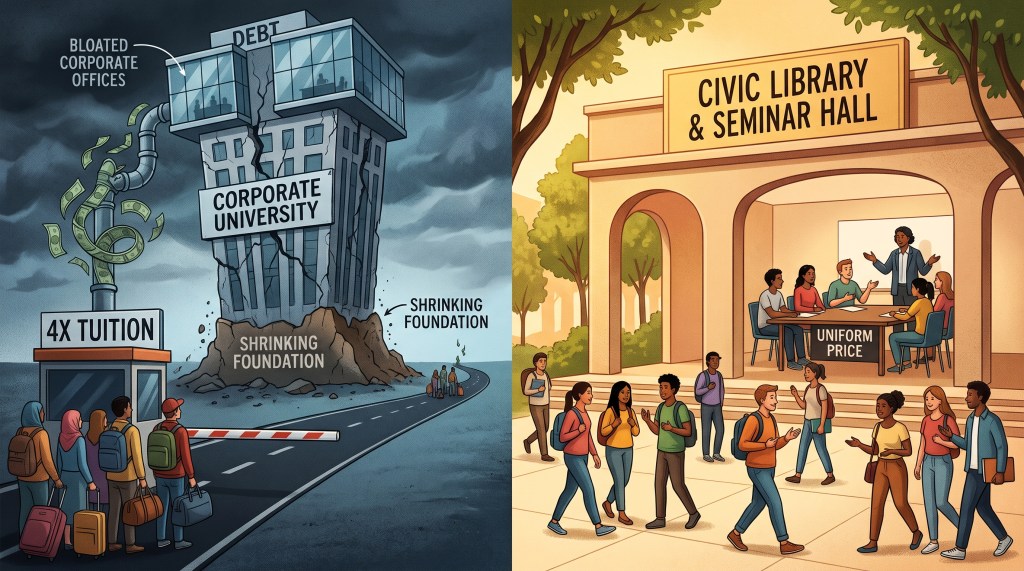
According to the Institute of International Education’s (IIE) annual Open Doors report released on November 16, 2026, total international student enrollment at U.S. colleges and universities dipped 2.7% to 1,146,163 during the 2025–26 academic year. Buried beneath that modest headline figure, however, lies a financial earthquake for university treasurers: new incoming international student enrollment plummeted 17.7% year-over-year, compounding a 7.2% drop the previous year.
The overall total was kept afloat only by a 14% surge in post-graduation Optional Practical Training (OPT) work authorizations (reaching 335,785 participants)—and IIE’s Fall 2026 Snapshot confirms that the contraction is accelerating, with active campus enrollment falling 9% (excluding OPT) and new arrivals dropping another 15% this fall. Simultaneously, NAFSA’s accompanying economic analysis revealed that international student spending fell by $3 billion (7%) to $39.9 billion in 2025–26, erasing more than 46,000 jobs, with the Fall 2026 decline projected to strip another $2.4 billion and 31,000 jobs from the U.S. economy. Major research institutions, including Boston University, are already pointing to the international downturn to justify budget retrenchment and layoffs.
Higher education trade associations and campus chief financial officers have reacted to these numbers with predictable alarm, warning of severe budget shortfalls across public flagships and private research universities alike. Yet what university executives portray as an external geopolitical or visa crisis is, at its root, the inevitable reckoning of an extractive corporate business model.
The Immoral Shell Game of Geographic Arbitrage
For the past three decades, the corporate higher education institution (Universitas) balanced its books by turning international admissions into an aggressive, commercial export arbitrage racket.
While published in-state tuition and fees at U.S. public four-year institutions average $11,500 to $12,300 per year ($13,000 to $18,000+ at public flagships), an international student sitting in the exact same lecture hall, listening to the exact same professor, and taking the exact same examination is billed $35,000 to $60,000+ per year. Across Canada, the United Kingdom, and Australia, the markup is even steeper, routinely reaching five to eight times domestic tuition rates.
EXTRACTIVE INTERNATIONAL ARBITRAGE
(CORPORATE CAMPUS)
[ International Student & Family ] (India, China, Global South)
• Liquidates generational savings & borrows at predatory rates
• Billed $35,000 to $60,000+ / year rack-rate tuition
│
▼
[ The Corporate Campus (Universitas) Financial Siphon ]
├── ~75% Skimmed for: • Municipal construction bond debt service
• Executive & administrative chancery payrolls
• Luxury campus amenities & global recruiters
└── ~25% Allocated to: • Overcrowded mega-lectures taught by
$3,500– $3,900 contingent adjuncts
│
▼
[ Systemic Fragility ]
• 17.7% drop in new arrivals triggers budget shortfalls & layoffs
To keep this revenue pipeline flowing, university administrations deployed armies of commissioned commercial recruiters across India (where sending numbers fell roughly 6% to 6.5% in 2025–26), China (down 4.3%), and the Global South. Middle-class families were induced to liquidate generational savings, sell ancestral property, and take on predatory private debt on the promise of Western institutional prestige. Upon arrival, those students were rarely met with dedicated mentorship from senior scholars; instead, they were herded into overcrowded business, computing, and economics mega-lectures staffed by underpaid contingent instructors or overworked graduate assistants.
Debunking the “Cross-Subsidy” Alibi
Whenever critics challenge this fourfold tuition markup, university CFOs and state budget directors invoke the Non-Resident Cross-Subsidization Defense (addressed directly in Chapter 4 of A New Tender for the Higher Education Social Contract): they claim that gouging international and out-of-state students is an indispensable fiscal necessity that subsidizes expensive STEM laboratories and keeps domestic resident tuition affordable.
The empirical ledger exposes this claim as an institutional falsehood.
Over the exact decades that international enrollments skyrocketed across North America and the Anglosphere, domestic in-state tuition did not stabilize—it rose at the fastest rate in modern history. According to federal IPEDS expenditure data, direct classroom instruction accounts for a blended national average of just 28.5% of postsecondary spending, while non-instructional and non-research activities consume 62% of institutional budgets.
The surplus extracted from international students was never used to democratize domestic access. Roughly 75 cents of every dollar was siphoned into non-instructional overhead: servicing 30-year municipal construction revenue bonds, expanding multi-tiered administrative bureaucracies, financing luxury student-life amenities, and compensating executive cabinets. Because fixed real-estate debt and managerial payrolls cannot contract when visa issuance tightens or geopolitical competition rises, a 17.7% drop in new international arrivals immediately throws debt-leveraged campuses into fiscal panic.
The PSA Remedy: Parsimonious Practice and the Uniform Professional Price
The Professional Society of Academics (PSA) dismantles this global extortion racket at its structural root by abolishing the corporate middleman (Universitas) and reconstituting higher education as an autonomous, self-governing profession (Societas).
Operating under an absolute statutory negative covenant barring real-estate ownership, capital debt issuance, and commercial endowment accumulation, the PSA strips away the 60% to 75% non-instructional overhead burden that forces legacy campuses to hunt for foreign cash cows.
THE PSA MODEL: THE UNIFORM PROFESSIONAL PRICE
[ Domestic Resident ]
├──► Pays Identical Base Rate ($333/credit hour)
[ International Scholar ] (~$10,000/yr full-time; zero 4x markup)
│
▼ Direct Educational Contract
[ Sovereign Licensed Scholar (Societas) ]
• $200,000 Solo Practice Baseline (200 enrollments)
• $120,000 Net Scholar Compensation
• $38,400 Guaranteed Human GTA Living Wage ($40/hr)
• Scale-Free Civic Spaces (Libraries, Storefronts, Hubs)
When higher education is organized through the micro-finances of Parsimonious Practice, the entire financial logic of international education transforms:
- 100% Solvency Without Cross-Subsidies: Under the PSA solo practice pro-forma, a licensed practitioner servicing a modest roster of 200 course enrollments per year at $333 per credit hour ($1,000 per 3-credit course, or $10,000 per year for a full-time 30-credit load) generates $200,000 in gross practice revenue. That baseline fully funds an upper-tier $120,000 net salary for the scholar, a mandatory $38,400 living-wage floor for a dedicated Graduate Teaching Assistant ($40.00/hour for 20 hours/week across 48 weeks), $24,000 for leased civic or commercial seminar space, comprehensive health and malpractice pools, and Society dues. Because the practice carries zero bond debt and zero administrative bloat, it requires zero geographic cross-subsidization to thrive.
- The Uniform Professional Price: With overhead eliminated, the PSA abolishes non-resident and international price discrimination entirely. An international student from Mumbai, São Paulo, Zhuhai, or Nairobi pays the exact same transparent, uniform professional fee as a student living three blocks from the seminar room—slashing the cost of an elite education by more than 75%.
- Genuine Local Economic Stimulus vs. Campus Enclosure: Under the legacy model, universities capture international student spending inside proprietary campus dormitories and dining monopolies. Under the PSA’s Scale-Free Civic Infrastructure, scholars convene human-scaled seminars in municipal libraries, civic cultural centers, and leased commercial offices. When international students reside in host cities to study with licensed practitioners, 100% of their housing, dining, transit, and retail spending flows directly into the local civic economy rather than an institutional balance sheet.
- Verified Rigor Over Corporate Branding: International families no longer have to gamble their life savings on opaque institutional rankings. Through Mutual Selectivity, anonymous front-end Quality Insurance (QI) peer audits of Course Difficulty Scores (CDS), and double-blind collective peer Quality Assurance (QA) recorded permanently on the Public Practice Record (PPR), global learners can inspect verified syllabi, exemplar student portfolios, and cohort outcomes directly before entering a contract.
The Open Doors numbers are a warning siren for a debt-leveraged institutional model that treats foreign students as balance-sheet collateral. By tearing down our inherited corporate border tollbooth and organizing under the Professional Society of Academics, society can replace predatory financial arbitrage with a genuine, accessible transnational Republic of Letters.


Leave a Reply