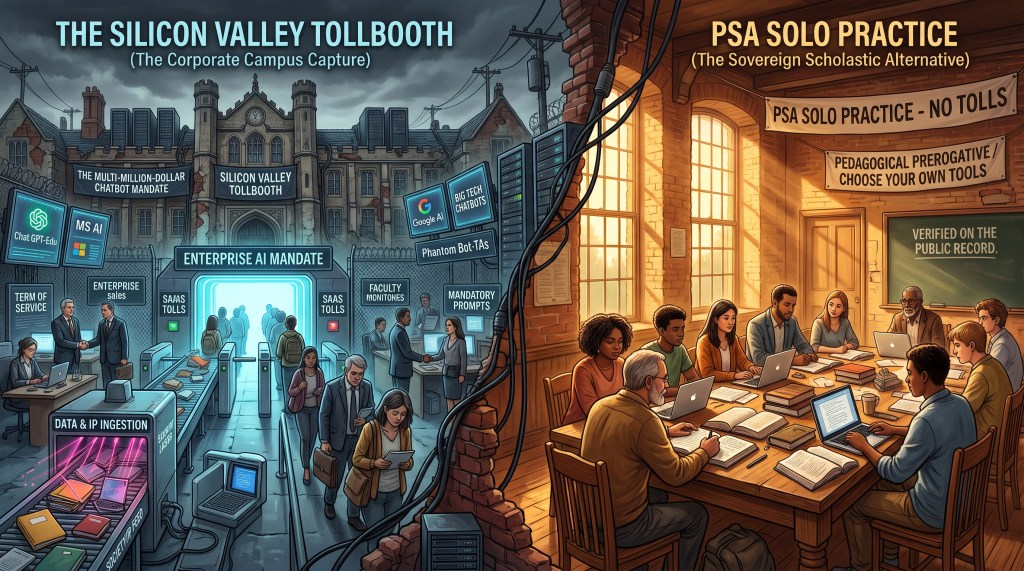
Across the United States, Canada, and the United Kingdom, campus administrations confronting structural budget deficits, bond rating downgrades, and demographic cliffs are making a curious fiscal calculation: they are signing multi-million-dollar enterprise licensing agreements with OpenAI (ChatGPT Edu), Microsoft, and Google.
Announced through breathless press releases orchestrated by campus marketing divisions, universities and colleges are aggressively re-branding themselves as “AI-native ecosystems.” Provosts and chancellors boast that by issuing enterprise seat licenses to every matriculating undergraduate, the institution is “democratizing personalization,” “streamlining academic workflows,” and “future-proofing the workforce.”
Behind the corporate jargon lies a darker operational reality: faculty are being subjected to top-down administrative mandates to re-engineer their courses around proprietary software platforms that will ultimately replace them.
Through centralized “Centers for Teaching Excellence” and provostial task forces, instructors are pressured to adopt institutional prompt-engineering frameworks, embed commercial chatbots into core syllabi, and require students to interact with commercial large language models (LLMs) for credit-bearing assignments. Most insidiously, faculty and student intellectual property—decades of refined lecture notes, bespoke problem sets, diagnostic feedback, and student essays—is being funneled directly into closed enterprise wrappers.
The corporate academy has effectively leased the lecture hall to Silicon Valley, forcing scholars to act as unpaid data annotators and systems trainers for multi-trillion-dollar tech monopolies.
The University as Enterprise Software Reseller
This latest frenzy cannot be understood as an organic pedagogical evolution; it is the grotesque continuation of the corporate university’s (Universitas) descent into an enterprise software sales channel.
Having spent the last two decades transforming the physical campus into a debt-leveraged hospitality complex, university management long ago adopted the doctrine of Enterprise Resource Planning. Institutions that routinely cry poverty when adjuncts demand living wages or when departments request photocopier paper think nothing of signing eight-figure contracts for Workday, Canvas, Blackboard, or Oracle. The administrative mindset reflexively views human labor as a fragile, expensive liability and corporate software as an unassailable asset.
          THE ENTERPRISE TECH TOLLBOOTH (THE CORPORATE CAMPUS)

  [ Silicon Valley Vendor ] (OpenAI / Microsoft / Google)
            │
            ▼ Multi-Million-Dollar Enterprise SaaS License
  [ University Chancery / Provost ] (The Middleman Reseller)
            │
            ├─► Imposes Top-Down Syllabi Mandates & Surveillance
            │
            ▼ Extracts IP & Conscripts Labor
[ Faculty (Locatio Operarum) ] ───► [ Student (Captive End-User) ]
 • Courses redesigned around LLMs    • Full tuition for a chatbot
 • IP ingested by commercial models  • Telemetry for Big Tech
Now, facing catastrophic operating deficits, managerial chanceries have identified the ultimate “bottleneck” to be resolved: the human instructor. In the eyes of an administrative vice-provost, reading a student’s essay, engaging in dialectical cross-examination, and coaching an apprentice through conceptual friction are hopelessly inefficient, non-scalable activities.
Rather than defending the unmediated encounter between teacher and learner, the corporate administration has transformed itself into a retail reseller for Big Tech. The university buys wholesale access to proprietary model endpoints, rebrands the interface with institutional logos, bundles the subscription into the student’s mandatory student-service fee invoice, and orders the faculty to ensure high daily-active-user metrics to justify the capital outlay. The historic seat of higher education is reduced to a glorified software distribution node.
Conscripted Craft: The Theft of Pedagogical Autonomy
For the professoriate, the enterprise AI mandate represents an existential violation of intellectual sovereignty:
- The Enclosure of Pedagogical Craft: Teaching is an idiosyncratic, relational art refined over lifetimes of study. Mandating that faculty format their syllabi to accommodate commercial chatbot outputs strips scholars of their authority over course design, reducing the educator from an autonomous master of a discipline into an administrative proctor servicing an external algorithmic engine.
- The Corporate Ingestion of Faculty IP: When universities partner with private AI vendors, they routinely require course materials to be hosted within the licensed institutional tenant. Faculty are urged to build custom “course bots” loaded with their proprietary monographs, lecture transcriptions, and evaluation rubrics. The institution claims this creates a “closed, secure environment”—deliberately obscuring the fact that it encloses the academic’s life work inside a proprietary platform whose contractual terms and architecture remain entirely beyond faculty control.
- The Degradation of the Student into an End-User: The student is no longer an apprentice entering a community of scholars; they are an enterprise seat license. They pay $12,000 to $50,000 in tuition not to sit across a seminar table from an expert, but to interact with an algorithmic simulator that generates average statistical completions of language.
The transaction is thoroughly cynical: the student is encouraged to believe that prompt engineering constitutes critical inquiry, while the university collects full tuition for an experience that costs the institution mere fractions of a cent per API call.
The PSA Remedy: Professional Prerogative and Technological Parsimony
The Professional Society of Academics (PSA) dismantles the Silicon Valley tollbooth by eradicating the corporate middleman that negotiated the concession.
Under the PSA framework, higher education is stripped of its corporate real-estate and managerial superstructure, reconstituting the academic vocation as an autonomous, self-governing profession (Societas). The model operates upon a foundational constitutional axiom: The First Principle: Liberty.
Intellectual inquiry requires the sovereign agency of both scholar and student. In the PSA, this principle is operationalized through professional prerogative:
           THE PSA MODEL: SOVEREIGN INQUIRY & CRAFT INTEGRATION

  [ THE PROFESSIONAL SOCIETY (SOCIETAS) ]
  • Statutory public trust; zero software reselling
  • Absolute prohibition on real-estate & corporate debt
  • Defends the inalienable freedom of academics by statute
                │
                ▼ Issues Portable Licensure (Locatio Operis)
  [ LICENSED SCHOLAR IN SOVEREIGN PRACTICE ]
  • Complete autonomy over tools, curriculum, and pedagogy
  • 100% intellectual property ownership
  • No provostial mandates; no forced corporate subscriptions
                │
                ▼ Direct Educational Contract (Mutual Selectivity)
  [ CITIZEN-STUDENT (APPRENTICE) ]
  (Human-scaled seminars; unmediated master-apprentice inquiry)
Under sovereign practice, the adoption of technology is returned entirely to the independent judgment of the practitioner:
- No Top-Down Software Dictates: There is no provost, no dean, and no enterprise IT committee with the legal standing to dictate what tools a scholar uses in practice. A scholar holding inalienable Portable Licensure is free to ban digital devices entirely—convening intensive, analog reading colloquia around original print volumes and handwritten disputations—or to deploy advanced, open-source computational scripts running on local hardware. The choice belongs to the practitioner, calibrated strictly to the epistemic demands of the subject and the developmental needs of the student.
- Technological Parsimony: The solo practice operates on a capitalized annual technology budget ($5,600/year) designed for parsimonious utility: high-speed connectivity, open databases, and hardware depreciation. Independent practitioners have zero incentive to sign multi-million-dollar software retainers that bloat practice overhead. If a software tool does not directly enhance human comprehension or research productivity, the practice simply does not buy it.
- The Open-Access Commons vs. Walled Gardens: While corporate HEIs sign non-disclosure agreements with proprietary tech conglomerates, the PSA’s statutory baseline funds a permanent, fee-free, diamond open-access publishing and repository platform. Primary research, course difficulty calibrations, and verified exemplar student monographs belong permanently to the public knowledge commons, protected by open licenses that prevent commercial enclosure.
Reclaiming the Seminar from the Algorithm
The corporate university’s embrace of enterprise AI is not an intellectual awakening; it is the panic of an insolvent institution attempting to automate away the only thing that justifies its existence: the human teacher.
By treating the lecture hall as an enterprise software sandbox, the legacy university has abandoned the social contract. It asks students to mortgage their futures for access to an institutional chatbot, while asking scholars to train the very machines intended to replace them.
Higher education cannot be fixed with an enterprise software patch. The reclamation of the social good begins with the recognition that critical intellect cannot be outsourced to a corporate subscription.
The classroom is not an enterprise sales territory; it is a sacred civic sanctuary. By organizing under the Professional Society of Academics, scholars can reclaim their professional sovereignty, refuse the role of corporate software brokers, and restore higher education to what it has always been: a living, unmediated covenant between human minds in search of truth.


Leave a Reply