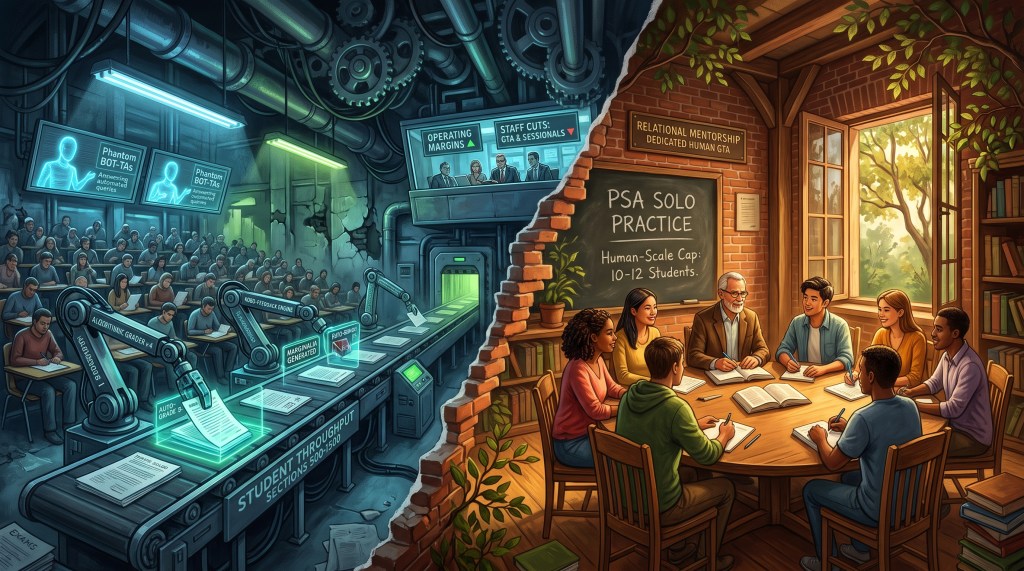
Across the landscape of major public research flagships and state mega-universities, an ominous technological experiment is quietly being normalized in the name of “innovation.” Faced with introductory survey courses packed with 500 to 1,500 undergraduates, campus administrations are deploying automated AI grading engines and synthetic “teaching assistant” bots. Marketed with Silicon Valley enthusiasm as breakthroughs that “streamline feedback” and “democratize instructional support,” these large language model systems ingest student essays, synthesize feedback rubrics, spit out instant marginalia, and staff 24/7 discussion boards with simulated conversational care.
Behind the public-relations veneer of pedagogical modernization lies a colder, purely fiscal objective: the elimination of the human instructional budget.
For university chief financial officers managing debt-heavy balance sheets, algorithmic grading is not an educational tool; it is a labor-liquidation strategy. By substituting generative software for human minds, administrations can quietly cut graduate teaching assistantships (GTAs), defund non-tenured sessional grading pools, and widen the operating margin of lower-division general education courses. The corporate university has reached its logical terminus: students pay full tuition to be processed by machines, while the savings are funneled into administrative payrolls, real-estate bond covenants, and campus branding campaigns.
And we are all left wondering: Why is anyone bothering to get a college education at all, if the machines are to replace us?
The Industrial Assembly Line: Taylorism’s Final Frontier
What higher education is witnessing is not an authentic intellectual evolution, but the final, grotesque application of Taylorism to the life of the mind.
In classical industrial engineering, Frederick Winslow Taylor sought to maximize capital efficiency by disassembling the holistic craft of the artisan into discrete, repetitive mechanical tasks, stripping the worker of autonomous judgment, and replacing human labor with machines. For over four decades, the corporate higher education institution (Universitas) has executed this exact de-skilling of the professoriate:
- It broke the holistic academic craft into commodified credit-hour chunks.
- It casualized over 70 percent of its faculty into disposable, piece-rate adjuncts.
- It transformed graduate students into an underpaid grading proletariat.
Now, having squeezed human labor to the point of exhaustion, the institutional factory is replacing the workers entirely.
THE CORPORATE ASSEMBLY LINE (MEGA-LECTURE ENCLOSURE)
[1,500 Enrollees] ──► [Asynchronous LMS / AutomatedModules ]
│
▼ Extracts Full Tuition
($10k–$35k)
Phantom Bot-TA ◄─── [ Generative Ingestion & Auto-Scoring ]
(Synthetic Feedback) │
▼ Siphons Surplus Capital
[ Real-Estate Bonds & Managerial Chancery ]
(GTAs Eliminated / Faculty Displaced)
In this digitized factory town, the student is not a scholar-in-training; they are an enrollment throughput metric whose tuition dollars unlock state capitation and federal loan liquidity. The synthetic “Bot-TA” is the automated assembly-line inspector, programmed to stamp raw student writing with simulated validation before routing the credential toward the registrar.
The resulting dynamic borders on the surreal: students use generative AI models to draft essays they have no interest in writing, which are then fed into automated grading bots that have no capacity to understand them, producing automated algorithmic critiques that no human eye will ever read. Yet the student is billed thousands of dollars for the experience, encumbering their economic future with non-dischargeable debt for a phantom education.
This inversion represents the absolute betrayal of U.S. President, James A. Garfield, who in 1871 reminded Williams College that higher education is an unmediated encounter: Mark Hopkins on one end of a log and a student on the other. In the automated corporate academy, the log has been replaced by a $100-million debt-leveraged glass complex, Mark Hopkins has been replaced by an algorithmic token-generator, and the student sits alone at a screen, isolated from any authentic community of inquiry.
The Manufactured “Scale” Dilemma
University administrators defend robo-grading as an unavoidable response to scale: “How else can a single faculty member manage a lecture of 1,200 students?”
The question itself is an institutional confession. It takes for granted the very pathology that needs dismantling: the 1,200-student mega-section.
Mass lecture enclosures exist for one reason only: to generate cash-flow surpluses for a corporate container that grossly undercapacitated. Large institutions herd freshmen into introductory stadiums to minimize direct instructional expenditures—spending less than twenty-eight cents of every operational dollar on classroom instruction—while siphoning the remaining sixty-five to seventy percent into non-instructional administrative bloat, student-amenity arms races, marketing agencies, and the servicing of massive municipal revenue bond portfolios.
Human mentorship is not scarce because scholars and graduate students are lacking. There are over 360,000 graduate assistants and 800,000 qualified adjuncts trapped in the national precariat, desperate for meaningful and materially viable academic work. Human mentorship is scarce because the corporate campus chooses to starve its instructional core to feed its administrative empire. The university cries poverty and installs automated grading bots while continuing to compensate executive cabinets with six-figure salaries and building luxury athletic complexes.
The PSA Remedy: Parsimonious Practice and De-Automated Craft
The Professional Society of Academics (PSA) renders automated grading and synthetic teaching assistants obsolete by design. It does so not by resisting technology, but by applying technological parsimony: using digital networks to lower overhead and eliminate administrative middlemen, rather than using automation to cheapen the human encounter.
Under the PSA, higher education is decoupled from the physical real-estate compound and reconstituted as an autonomous, self-governing profession (Societas). By operating under an absolute statutory negative covenant barring real-estate ownership and debt issuance, the PSA permanently terminates the non-instructional overhead drain.
        THE PSA RELATIONAL ENCOUNTER (PARSIMONIOUS PRACTICE)

[ Licensed Master Scholar ] <================> [ Citizen-Student ]
  ($120,000 Net Income)   Direct Covenant   (10–15 Person Seminar)
      │                                 │
      │ Co-Teaches & Mentors            │ Real Diagnostic Critique
      ▼                                 ▼
[ Dedicated Human GTA Apprentice ] ─────┘
(Guaranteed $38,400 Living-Wage Floor: $40/hr, 20 hrs/wk)
               │
               ▼ Summative Verification (QA)
[Double-Blind Peer Panels on the Public Practice Record (PPR]
When the corporate tollbooth is removed, the economics of higher education shift dramatically:
- Human-Scaled Seminars by Default: Because an independent solo practice sustains an elite $120,000 net professional income on just 200 course enrollments across an entire calendar year, the 1,500-student mega-section is abolished. Instructors convene intimate seminars of 10 to 15 students in leased civic and commercial spaces—municipal libraries, cultural centers, and downtown office suites.
- Guaranteed Human Graduate Apprenticeships: The PSA solo practice pro-forma statutorily budgets $38,400 annually to employ a dedicated human Graduate Teaching Assistant (GTA), guaranteed a living wage of $40.00 per hour for 20 hours per week over 48 weeks. The GTA is not a sweated piece-rate grader trapped in a basement; they are a recognized Apprentice Practitioner working alongside a licensed master, learning the craft of seminar leadership, historiographical debate, or laboratory synthesis.
- Formative Assessment as an Unmediated Human Trial: Under the PSA, ongoing diagnostic critique is the unmonitored sovereign prerogative of the instructor and their apprentice. Line-by-line marginalia, oral cross-examination, and substantive revision are restored as living feedback loops between human minds. A machine cannot identify the subtle emergence of original critical voice; only a practicing scholar can guide an apprentice through conceptual friction. And anyway, what would these people do if the machine was to replace them?
- Algorithmic Quality Without Robotic Pedagogy: Where does the PSA deploy computational power? Not in the classroom to replace the teacher, but in the administrative switchboard to eliminate bureaucratic corruption. The Society uses algorithmic routing to manage the double-blind peer-review clearinghouse (QI/QA)—randomizing external peer examiners, auditing Course Difficulty Scores, and permanently recording anonymized student portfolios on the Public Practice Record. Technology is used to keep the governance manageable and incorruptible, leaving the educational act entirely human.
Beyond the Synthetic Campus
The university establishment presents algorithmic grading as the inevitable march of progress. It is nothing of the kind. It is the defensive triage of an obsolete corporate business model attempting to preserve its real-estate empire by cannibalizing the last remnants of its educational integrity.
Higher education does not need “Bot-TAs” to manage mass alienation. It needs to dismantle the corporate lecture factory that manufactured that alienation in the first place.
By grounding the academic craft in sovereign, licensed practices within the social economy, the Professional Society of Academics proves that society can fully fund human-scaled seminars, provide graduate assistants with authentic living wages, and restore the dignity of unmediated mentorship—all while slashing the public cost of higher education by more than half. The future of higher learning does not belong to synthetic corporate algorithms wrapped in institutional brands; it belongs to the enduring covenant between living scholars, dedicated student, and the human community they serve.


Leave a Reply