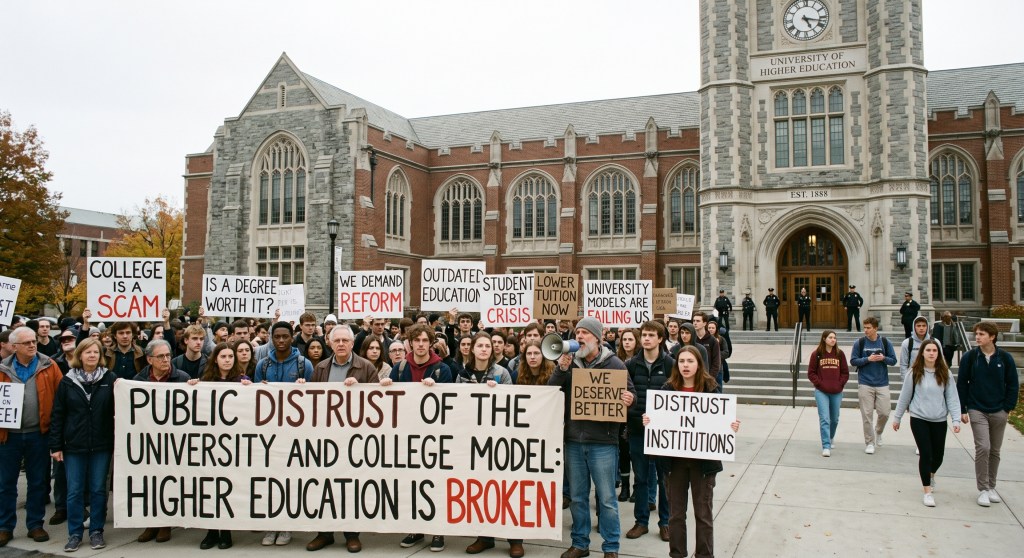
If you spent any time logged into the virtual ether of The Chronicle of Higher Education’s flagship festival, “Building Trust During Change,” you were treated to one of the greatest spectacles in modern corporate theater.
For days, thousands of senior university administrators, provosts in bespoke eyewear, and deans broadcasting from mahogany-paneled home offices gathered in Zoom breakout rooms to ponder a profound, agonizing cosmic mystery: Why doesn’t anyone trust us anymore?
Panel after panel of executives scratched their collective chins over the public’s “eroding confidence” in higher learning. They clicked through PowerPoint decks tracking Gallup polls, analyzed “demographic cliffs,” and brainstormed how to better “frame the value narrative.” They talked about “stakeholder alignment,” “transparent communication channels,” and “amplifying student-centered impact stories.”
The consensus from the executive suite? Higher education has a messaging problem. The public is simply misinformed. If campuses can just optimize their brand storytelling, produce slicker TikTok content about first-generation resilience, and hire the right crisis-communications consultants, the public will finally remember how lucky they are to have them.
It is a masterclass in institutional gaslighting.
College leaders want to treat a predatory, extractive business model as a minor public relations hiccup. They are holding multi-million-dollar retreats to ask why the village is mad at the toll bridge, while actively raising the toll and narrowing the lane.
Let’s break down the mystery that these administrators somehow couldn’t solve between their morning keynote and their afternoon networking breakout.
The Clues to the “Mystery”
If higher education administrators are genuinely confused about why students, parents, politicians, and working-class citizens view their institutions with a mixture of rage and cynicism, they don’t need a consulting firm. They just need to open the AAUP’s Annual Report on the Economic Status of the Profession and read the scoreboard.
Here is why nobody trusts the corporate campus:
1. The $1.77 Trillion Extortion Racket
For forty years, universities have raised tuition at double or triple the rate of inflation, forcing two generations of students into a staggering $1.777 trillion national debt trap.
Administrators love to call this “student debt,” as if an eighteen-year-old made an eccentric personal luxury purchase like buying a yacht on credit. It isn’t student debt; it is higher education production debt. The corporate university (Universitas) constructed an artificial monopoly over credentialing, locked the doors to the middle class behind statutory accreditation, and then told young citizens: Sign this federally guaranteed debt contract, or spend your life sorting packages in a warehouse.
When a student takes on $38,000 in personal debt to get an undergraduate degree, and then graduates into an economy where their diploma buys them an unpaid internship and an entry-level salary that can’t cover rent, they don’t have a “messaging” problem with their alma mater. They realize they were shaken down.
2. The $4,000 Plantation Engine
The public might swallow exorbitant tuition if they thought the money went to supporting world-class scholars who dedicate their lives to teaching their kids.
Except the public now knows the secret: the university doesn’t pay its teachers.
As the AAUP’s 2025–26 data makes painfully clear, 68.2 percent of the entire American faculty is trapped in contingent appointments ineligible for tenure. Nearly half (48.6 percent) are part-time adjuncts. Across more than 400 reporting institutions, the average pay for an adjunct teaching a full, semester-long, three-credit course was $4,093.
Figure 3 of the report shows that at 70 percent of reporting colleges, minimum course pay was $4,000 or less. In master’s institutions, the average drops to $3,200. Thirty-one institutions reported paying under $1,000 for an entire semester of college-level instruction. Meanwhile, 69.2 percent of colleges contribute zero healthcare benefits to their part-time faculty, and 67.1 percent provide zero retirement contributions.
Imagine charging a student $60,000 in tuition, dumping them into a 250-person introductory lecture hall, paying the Ph.D. at the front of the room $3,500 with no health insurance, and then hosting a four-day webinar to ask why people question your “ethical core.”
3. The Seven-Figure Ivory Tower
Where did all that tuition money go, if not to the teachers?
Table 11 of the AAUP report provides the punchline: it went to the people attending The Chronicle’s festival.
The median base salary for a president at a private doctoral institution is now $850,000, with top corporate earners pulling down over $2.02 million. Even at public doctoral universities, median presidential pay sits at $651,084. Chief Academic Officers are clearing a median of $441,000, while Chief Financial Officers pull down $387,000. At private doctoral institutions, the median president earns 5.44 times more than a full professor—and an astronomical 207 times more than an adjunct teaching a course.
Add to this the $2 trillion national backlog in deferred campus maintenance, the bloated marketing divisions, the campus police forces, and the luxury athletic complexes, and the picture comes into focus.
The modern university is a luxury real-estate hedge fund that operates a sports franchise and an outsourced gig-economy call center, using undergraduate classrooms as a tax-exempt loss leader.
And the executives are wondering why the public has “trust issues.”
You Can’t PR Your Way Out of an Extractive Monopoly
When an institution’s fundamental economic model relies on exploiting its workers and indebting its users, you cannot fix the relationship with “better storytelling.”
Consider what historian Steven Mintz and countless higher ed apologists routinely preach when diagnosing student alienation: Colleges need to hire more advisors, spend more money on belonging initiatives, and create expensive co-curricular programs to make students feel valued.
It is the corporate university’s favorite trick: solve the problems created by administrative bloat by adding more administrative bloat.
If students feel alienated, don’t lower their tuition or let them study in a seminar of eight people with a well-paid professor. Instead, hire an Associate Dean of Student Belonging at $160,000 a year, build an espresso bar in the student union, and launch an app where freshmen can earn digital wellness badges.
Trust isn’t built on branded marketing campaigns. Trust is built on unmediated structural integrity:
- You cannot build trust when an adjunct professor grades essays out of their car between shifts at Starbucks because the college won’t give them an office or health insurance.
- You cannot build trust when an institution cancels an advanced philosophy or literature seminar because only seven students enrolled and the corporate break-even algorithm demands fifteen.
- You cannot build trust when boards of trustees surrender academic freedom and sign multi-million-dollar compliance settlements the second federal politicians threaten their bond ratings.
Students, parents, and citizens don’t hate higher education. They love learning, they revere genuine expertise, and they crave intellectual mentorship.
What they despise is the higher education institution—the corporate middleman that stands between the scholar and the student, charging a 600 percent markup to maintain its administrative empire.
The PSA Architecture: How Real Trust Is Built
The tragedy of gatherings like The Chronicle Festival is that everyone in the room assumes there is no alternative. They assume that higher education, by definition, requires an employer-enroller corporation (Universitas), an $850,000 president, an accreditational cartel, and an exploited underclass.
The Professional Society of Academics (PSA) was designed precisely to explode that assumption.
We do not need to “rebuild trust” in the corporate university. We need to execute a Great Decoupling and organize higher learning around the sovereign, horizontal guild (Societas).
Here is what educational trust actually looks like when you eliminate the corporate landlord:
1. The Direct Contract Replaces Tuition Extortion
In the PSA, students do not pay an institutional conglomerate tens of thousands of dollars to subsidize campus debt and executive bonuses. Through the Direct Contract, the student enters a direct educational covenant with the practicing academic.
Under the PSA principle of Parsimonious Practice, all the non-instructional administrative rot is eliminated. A licensed scholar charging an accessible $800 to $1,000 per student for a comprehensive, semester-long credit seminar can teach an intimate cohort of 10 to 12 students. That generates an immediate, robust return for the practitioner while costing the student a tiny fraction of corporate tuition. No loan sharks, no federal financial-aid bondage, no institutional overhead.
2. Mutual Selectivity Replaces the Admissions Algorithm
Trust cannot exist when students are sorted by automated enrollment funnels and dumped into mass lecture halls to satisfy an institutional business plan.
In the PSA, academics take on students the way independent attorneys take on clients or physicians take on patients. It is a relationship of mutual selectivity. The scholar personally admits the student into their practice based on genuine intellectual curiosity and shared commitment. If a student struggles, the scholar doesn’t refer them to an outsourced administrative helpline; the scholar works with them directly, because their professional standing and reputation are directly on the line.
3. Objective Peer Audits Replace Campus Propaganda
University marketing departments spend millions churning out glossy viewbooks with doctored photos of diverse students smiling under autumn foliage.
The PSA replaces corporate PR with the Public Practice Record (PPR) ledger.
- A scholar’s verified teaching history, student cohort outcomes, Course Difficulty Scores (CDS), and scholarly contributions are inscribed on an open-access, immutable public ledger.
- Student work is assessed through blind, objective peer evaluation conducted across the transnational Guild, obliterating the corrupt customer-satisfaction grading and grade inflation that corporate administrations use to retain tuition revenue.
When a student enrolls in a PSA practice, they don’t need a university branding video to tell them the education is good. The rigor is transparent, verified by professional peers, and visible to the entire world.
Stop Watching the Festival. Build the Guild.
To the university administrators wrapping up their panels on “navigating skepticism”: you can close your laptops now.
You cannot restore trust in a system whose foundation is built on $4,000-a-course labor and $1.77 trillion in public debt. You cannot market your way out of a mathematical reality. Every time an adjunct professor qualifies for food stamps while your campus cuts ribbons on a new administrative center, your “trust initiatives” turn to ash.
The future of higher education isn’t going to be engineered in a Chronicle Zoom summit. It will be built by scholars who are tired of being treated as disposable factory hands on an institutional payroll.
It will be built when academics decouple their intellectual authority from the corporate campus, claim their Portable Licensure, and open sovereign public practices in municipal libraries, leased storefronts, and local civic knowledge hubs.
Real higher education doesn’t need an $850,000 president to tell its story. It just needs a scholar, a student, and the freedom to pursue the truth without a landlord standing between them.


Leave a comment